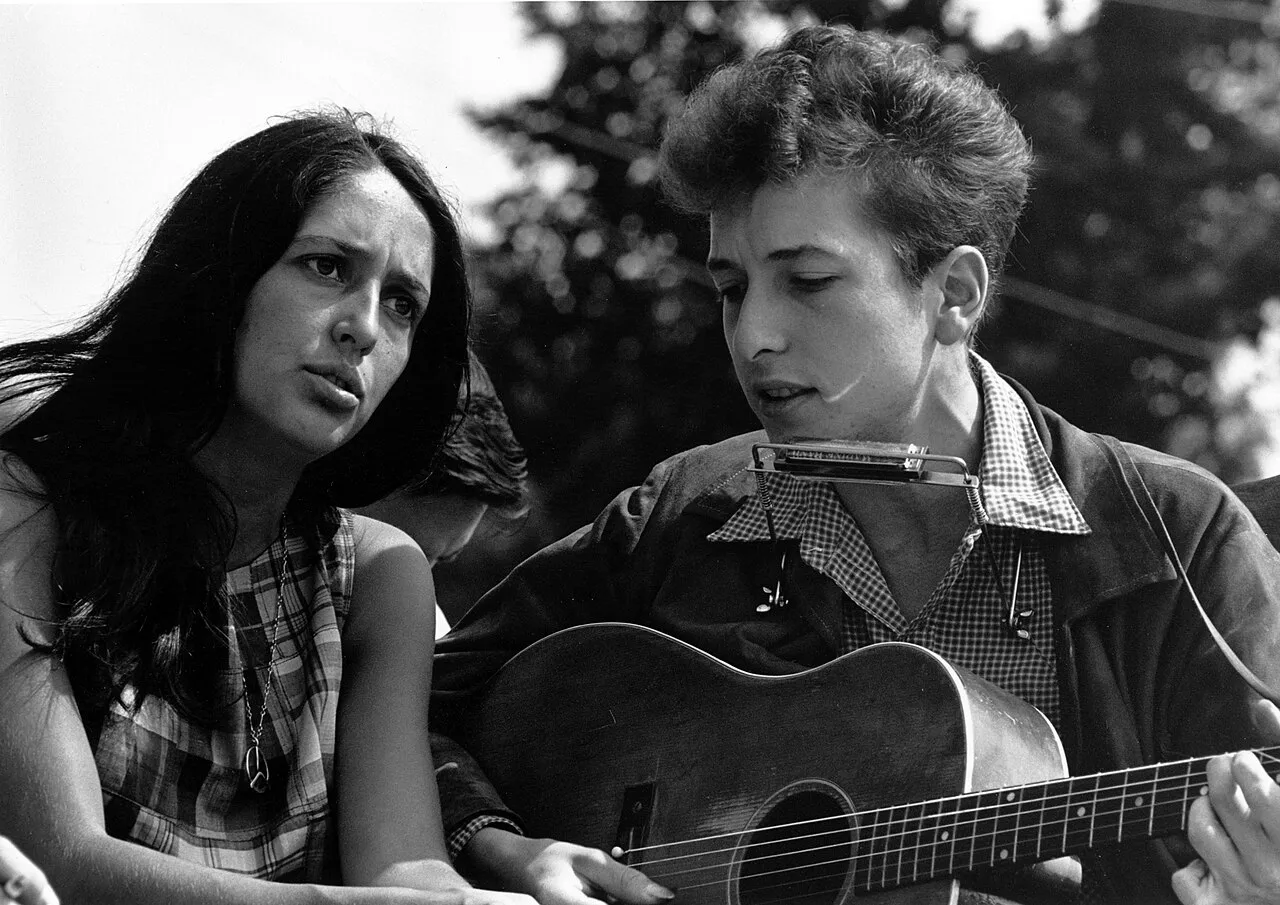
Joan Baez and Bob Dylan at the March on Washington for civil rights on August 28, 1963. Photo by Rowland Scherman, U.S. National Archives, Wikimedia Commons, public domain.
DefinitionA song that calls for immediate social or political change.
Other namesIn French, you’ll hear chanson engagée, chanson contestataire, or chanson protestataire. In English, it’s a “protest song.”
Common themesWar, racism, poverty, freedom of speech, and sexism.
A landmark recordingBillie Holiday recorded “Strange Fruit” in 1939. Time magazine named it song of the century.
01
Start by listening
“Get Up, Stand Up,” written by Bob Marley and Peter Tosh, gets its message across in a single chorus. Watch Bob Marley and the Wailers play it at the Sundown Theatre in Edmonton, England, in May 1973.
“Get Up, Stand Up” (live at the Sundown Theatre, 1973), Bob Marley and the Wailers. Bob Marley’s official channel released the footage in 2023 for the 50th anniversary of “Catch a Fire.”
02
What are protest songs?
A protest song carries a message. The singer is asking for social or political change, often urgently. In French, you’ll also hear chanson contestataire or chanson protestataire. The English term is “protest song.”
Speaking on France Inter in 2013, the singer Kent drew a distinction. A chanson engagée takes a side and campaigns for a cause. A chanson révoltée may simply call out a wrong. For American singer Phil Ochs, a protest song had to say something too specific to dismiss as empty talk.
The same themes come up in each generation, and many of these songs end up sung in unison in the streets.
03
A short history in songs
1939
Billie Holiday records “Strange Fruit” on April 20 for the Commodore label. The lyrics, by Bronx English teacher Abel Meeropol, condemn the lynching of African Americans. In 1999, Time magazine names it song of the century.
1940
Woody Guthrie writes “This Land Is Your Land” in New York in response to “God Bless America,” which he is tired of hearing on the radio. Two verses deal with private property and hunger during the Great Depression.
1954
Boris Vian writes “Le Déserteur” in February during the Indochina War. Mouloudji sings it onstage on May 7, the day of the defeat at Diên Biên Phu. The song is soon banned from the radio. The ban stays in place until 1962.
1963
Bob Dylan releases “Blowin’ in the Wind” in May on “The Freewheelin’ Bob Dylan.” Peter, Paul and Mary’s version reaches No. 2 on the U.S. chart, and the song becomes a civil rights anthem.
1964
Moved by Dylan’s song and turned away from a hotel in Shreveport, Louisiana, because of racism, Sam Cooke writes “A Change Is Gonna Come.” It becomes a civil rights anthem too.
1969
Creedence Clearwater Revival protests the Vietnam War with “Fortunate Son,” a song about the unfairness of the draft. Joan Baez sings “Le Déserteur” at U.S. peace marches during those years.
1973
“Get Up, Stand Up” comes out on the Wailers’ album “Burnin’.” It’s the last song Bob Marley sings onstage, on September 23, 1980, in Pittsburgh.
1976
In Nigeria, Fela Kuti releases “Zombie,” a sharp attack on Nigerian soldiers. The public loves it. The authorities take a dim view.
1980
Peter Gabriel releases “Biko” in honor of Steve Biko, the South African anti-apartheid activist who died in detention in 1977. South African authorities ban the song.
04
In French
French-language song has its own protest tradition. “Le Chant des partisans” takes shape in London in 1943, with lyrics by Joseph Kessel and Maurice Druon and music by Anna Marly. In 1971, Jean Ferrat sings “La Commune” for the centenary of the Paris Commune. Renaud’s 1975 debut album includes “Hexagone.” In 1977, Pierre Perret takes on racism in “Lily.”
Alain Souchon takes a quieter approach in “Foule sentimentale” (1993), calling out the emptiness of consumer society.
05
Voices from Africa
For these artists, singing against injustice could mean arrest, exile, or a military raid. Listen to four voices from South Africa, Nigeria, and Côte d’Ivoire.
Miriam Makeba
South Africa
Born in Johannesburg in 1932, she became known as “Mama Africa.” In 1960, South Africa revoked her passport as she was trying to return for her mother’s funeral. That began 30 years in exile. In 1963, she spoke out against apartheid at the United Nations. She returned in 1990 at Nelson Mandela’s insistence.
Listen “Pata Pata” (1967). “An Evening with Belafonte/Makeba,” which won a Grammy in 1966 with Harry Belafonte. “Soweto Blues” (1977), about the Soweto uprising.
Born in Abeokuta in 1938, Fela Kuti died in Lagos in 1997. He is widely credited as the main creator of afrobeat. After “Zombie,” a thousand soldiers attacked his communal home, the Kalakuta Republic, in 1977 and burned it down. They threw his mother out a window, and she died of her injuries. Fela took her coffin to Dodan Barracks in Lagos, where General Obasanjo lived, and answered with songs.
Listen “Zombie” (1976) and “Coffin for Head of State,” written after the attack.
Born Seydou Koné in Dimbokro, he sings mainly in Dioula, French, and English. On his 1982 debut album, “Brigadier Sabari” recounts his arrest in Abidjan and the police brutality that followed. In 2005, the UN named him a peace ambassador for Côte d’Ivoire.
Listen “Brigadier Sabari” (1982) and “Apartheid Is Nazism” (1985), a call to end apartheid.
He was born in Odienné in 1968. His 2002 album “Françafrique” won a Victoire de la musique in 2003. After receiving death threats, he went into exile in Mali. Through “Un concert, une école,” an initiative launched in 2009, he funded a school near his hometown.
Listen “Françafrique” (2002), “Plus rien ne m’étonne” (2004), and “Ouvrez les frontières” (2007), a duet with Soprano.
You can find more artists from Africa and around the world on our artist pages.
06
Today
Artists are still writing protest songs. In Tunisia, Emel Mathlouthi’s “Kelmti Horra,” meaning “my words are free,” became an anthem of the 2010 and 2011 revolution.
In the United States, young Black Lives Matter protesters sang the chorus of Kendrick Lamar’s “Alright” (2015) together. In 2019, Childish Gambino’s “This Is America,” about racism and gun violence, became the first rap song to win the Grammy for song of the year.
In French, Angèle takes on everyday sexism in “Balance ton quoi” (2018), whose title refers to the #BalanceTonPorc movement. Some artists make their point more quietly. Michael Jackson addresses the environment in “Earth Song” (1995), and Stromae drew on an encounter with a homeless person for “Formidable” (2013).
07
Explore further
Read the full lyrics, dig into a song’s history, or find more songs to listen to.
They carry a social or political message and call for change. In French, you may hear chanson engagée or chanson contestataire. In English, the usual term is “protest song.”
What are some famous protest songs?
You might know “Strange Fruit,” “This Land Is Your Land,” “Blowin’ in the Wind,” “A Change Is Gonna Come,” “Le Déserteur,” “Get Up, Stand Up,” and “Zombie.” The first three are in the National Recording Registry at the U.S. Library of Congress.
Which French-language protest songs can you listen to?
Try Boris Vian’s “Le Déserteur,” “Le Chant des partisans,” Jean Ferrat’s “La Commune,” and Pierre Perret’s “Lily.” Later examples include Angèle’s “Balance ton quoi” and Tiken Jah Fakoly’s “Françafrique.”
What are some recent protest songs?
Kendrick Lamar’s “Alright” (2015), Childish Gambino’s “This Is America” (2018), and Angèle’s “Balance ton quoi” (2018), which takes on sexism.
Which songs protested the Vietnam War?
Creedence Clearwater Revival’s “Fortunate Son” (1969) became an anthem of the antiwar movement. So did “Blowin’ in the Wind.” Peter, Paul and Mary and Joan Baez also sang “Le Déserteur” in the United States.
Sources
Chanson engagée, French Wikipedia (definition, Kent’s distinction, and French-language song). Protest song, English Wikipedia (Phil Ochs’s definition, Dylan, and “Kelmti Horra”).