Ragas, sitar, and tabla from northern to southern India
A sitar rings out. A tabla answers. One note sounds from start to finish. Indian classical music has two traditions, one in the north and one in the south. Both are built on raga and tala. Hindi film songs make up a large part of Indian pop.
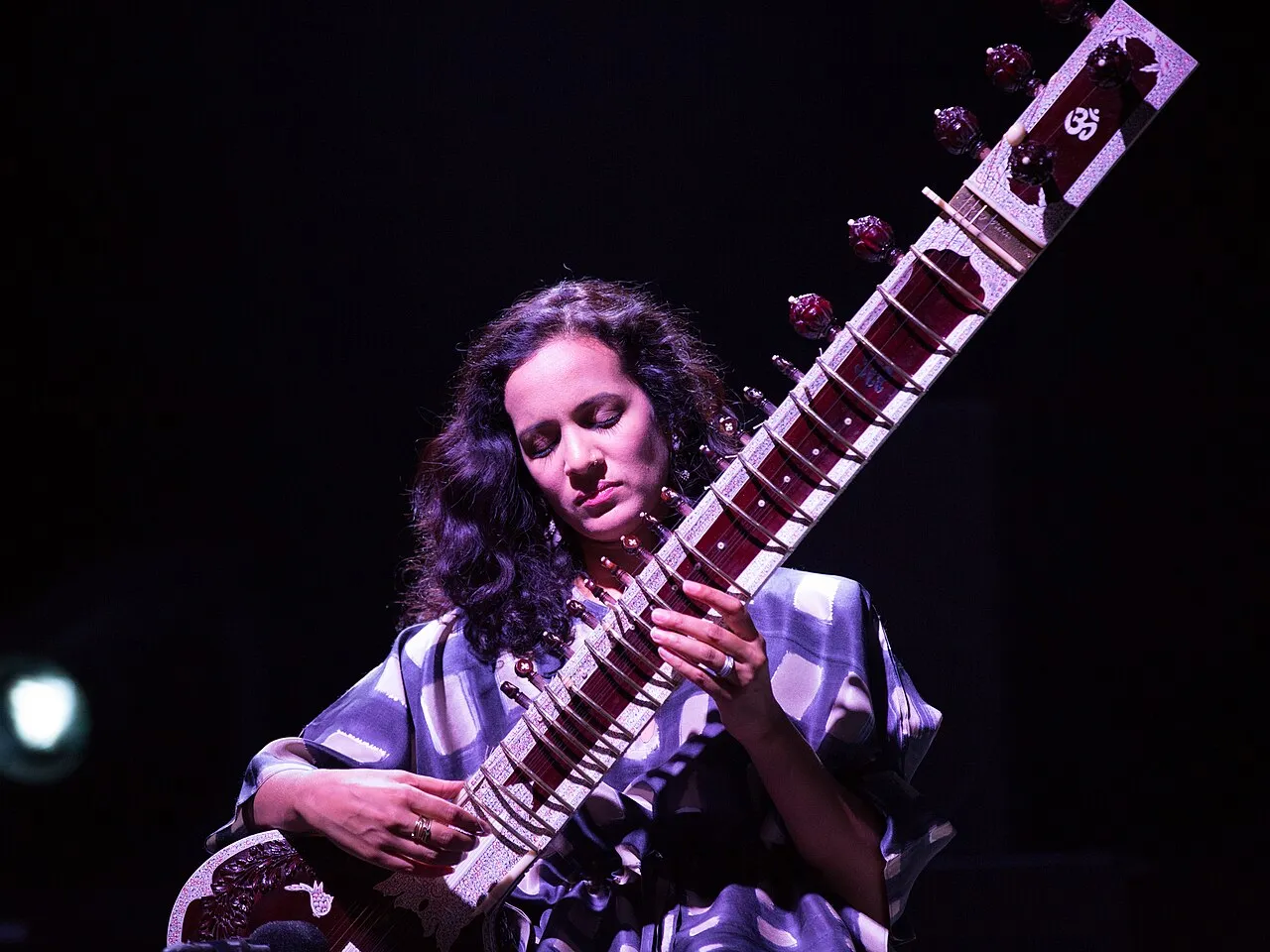
Anoushka Shankar at the Rudolstadt Festival, 2016. Photo by Harald Krichel, Wikimedia Commons, licensed under CC BY-SA 4.0.
Two traditionsHindustani music in the north and Carnatic music in the south diverged around the 12th century.
RagaA melodic framework for improvisation. In Sanskrit, the word means “coloring.”
TalaA rhythmic cycle. Teental, the standard cycle in the north, has 16 beats.
FilmHindi film songs make up a large part of Indian pop.
01
Start by listening
On February 7, 2012, two months before his 92nd birthday, Ravi Shankar played his final concert in India with his daughter Anoushka in Bangalore. Here they play raga Khamaj, with Tanmoy Bose on tabla and Pirashanna Thevarajah on mridangam, a drum from southern India.
“Raga Khamaj & Medley” (live), Ravi and Anoushka Shankar in Bangalore. Released by the Ravi Shankar Foundation in 2015.
02
Two major traditions
Both branches use raga for melody and tala for rhythm. They diverged around the 12th century. Their roots go back to Hindu texts, including the Samaveda.
Hindustani music
Northern India
Persian music influenced Hindustani music during the Middle Ages. It flourished at the Mughal court and later developed into schools of style called gharanas. Dhrupad and khyal are its main vocal forms. The sitar, sarod, and tabla are its signature instruments.
Carnatic music
Southern India, around Chennai
The voice comes first here. Even on violin or veena, musicians play “in the style of singing.” The repertoire is built around compositions, especially the kriti, which Tyagaraja, Muthuswami Dikshitar, and Syama Sastri helped develop in the 18th and 19th centuries.
Chennai remains the heart of Carnatic music. Its major concert season began in 1927. In 1998, Carnatic singer M. S. Subbulakshmi became the first musician to receive the Bharat Ratna, India’s top civilian honor.
03
Raga and tala
A raga is a framework for melody. A set of notes and characteristic phrases give it an identity beyond a scale or a tune. Musicians improvise within that framework, so one raga can yield endless melodies. There are hundreds of ragas, with about 30 in common use.
Each raga has its own mood. In the north, many are tied to a time of day, whether morning, afternoon, evening, or night.
A tala is a repeating cycle of beats. In the north, teental is the usual cycle, with 16 beats in four groups of four. In the south, adi tala has eight beats. The first beat, the sam, gets the strongest accent. It’s where the soloist and percussionist come back together.
Underneath it all, the tanpura, a four-string lute, sustains a continuous drone throughout. Its role is to hold that sound while the melody unfolds. In the north, the alap is an improvisation in free rhythm. In instrumental music, the jod and jhala follow, and the tempo picks up in stages.
04
Instruments
The sitar. Ravi Shankar brought this Hindustani lute to audiences around the world. It has 18 to 21 strings. The player plucks six or seven, and the others run beneath the movable frets and resonate in response. The body is made from a gourd.
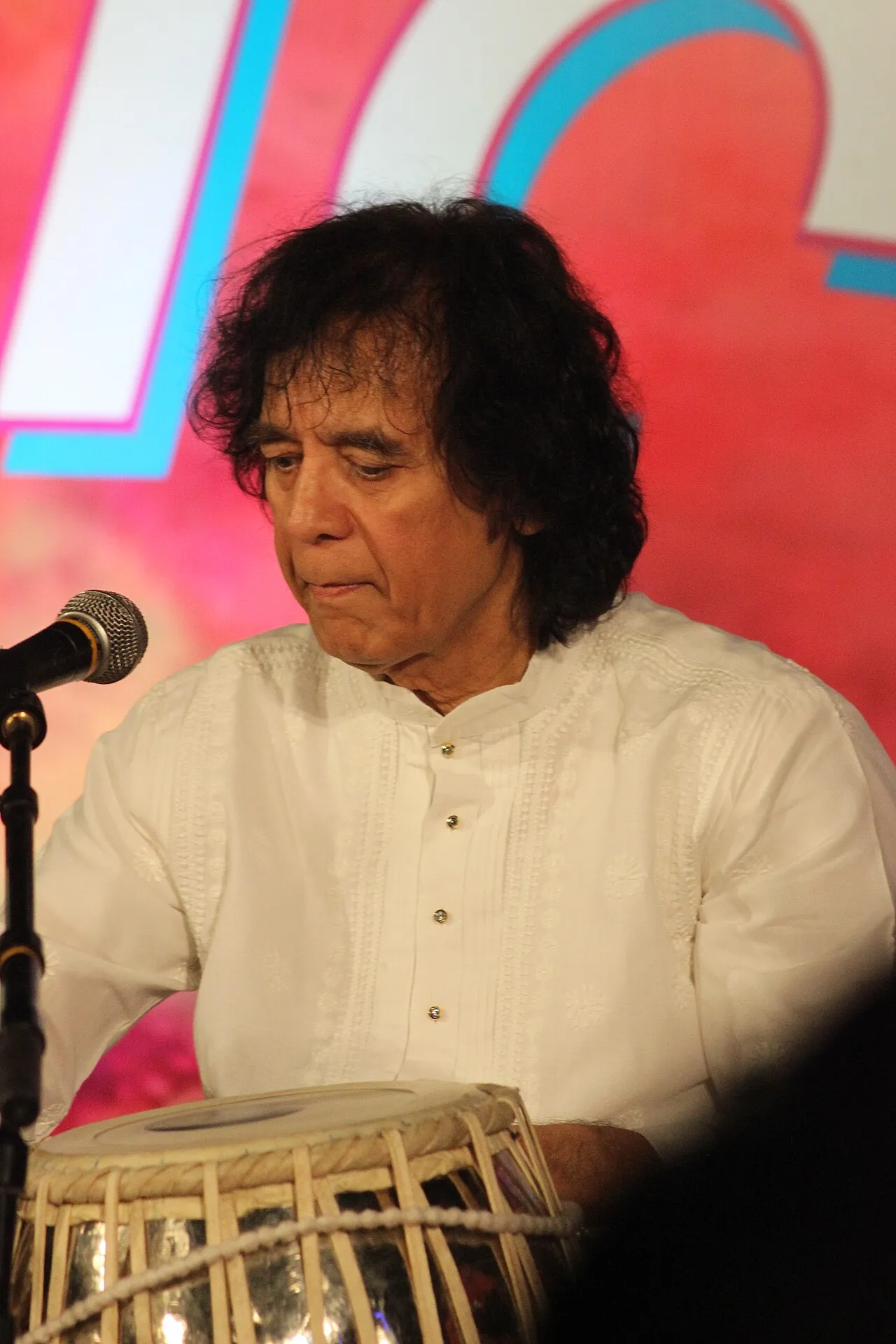
The tabla. Two small drums played with the fingers and palms. The dayan is the higher drum, and the bayan is the bass drum. The black spot on each drumhead, called the syahi, is a paste that brings out the overtones.
Zakir Hussain playing tabla at Bharat Bhavan in Bhopal, 2019. Photo by Suyash Dwivedi, Wikimedia Commons, licensed under CC BY-SA 4.0.
The sarod. A fretless lute with metal strings and a deep, low sound. The player’s hand slides from note to note. Ali Akbar Khan was a master of the instrument.
The bansuri. A side-blown bamboo flute with six or seven holes and no keys. Hariprasad Chaurasia made it a concert instrument.
The veena. A large southern Indian lute, about 1.2 meters long. Its body is hollowed out of a block of wood, usually jackfruit wood. It has 24 frets on its neck and four playing strings.
05
Beyond classical music
In India, songs often reach you through movies. Hindi film songs, or Bollywood music, make up a large part of Indian pop. In northern India, you can hear them in markets, on buses, and on trains. Studio vocalists called playback singers record the songs, and the actors lip-sync the words.
1967
“West Meets East,” Ravi Shankar’s album with violinist Yehudi Menuhin, won the 1967 Grammy for chamber music, a first for an Asian musician.
2009
“Jai Ho,” composed by A. R. Rahman for “Slumdog Millionaire,” won the Oscar for best original song.
2023
“Naatu Naatu,” a Telugu-language song from “RRR,” later won the same Oscar.
06
Musicians to listen to
Ravi Shankar
India, sitar
Born in 1920 in Benares, now Varanasi, he studied sitar for seven years with Allauddin Khan. From Monterey in 1967 to Woodstock in 1969, he played ragas for rock audiences. George Harrison of the Beatles took lessons with him. He died in 2012.
What to listen to “West Meets East” (1967) with Yehudi Menuhin. “Live in Bangalore,” his final concert in India, with Anoushka (released in 2015).
Born in Bombay in 1951, he was the son of tabla player Alla Rakha. He gave his first concerts at age seven. He and guitarist John McLaughlin co-founded Shakti, which brings together musicians from northern and southern India. He died in 2024.
What to listen to “Planet Drum” (1991) with Mickey Hart. “This Moment” (2023) with Shakti.
Born in Allahabad in 1938, he learned music in secret. His father was a wrestler and wanted him to become one too. He played on the radio, then worked in film in Bombay. He and Shivkumar Sharma composed scores for films such as “Silsila.” You can also hear him on “The Inner Light,” a 1968 Beatles B-side.
What to listen to “Call of the Valley” (1968) follows a Kashmiri shepherd’s day in ragas from morning to evening, with Shivkumar Sharma on santur and Brij Bhushan Kabra on guitar.
Born in London in 1981, Ravi Shankar’s daughter gave her first concert at age 13 in New Delhi, with Zakir Hussain on tabla. In 2006, she became the first Indian musician to perform at the Grammy Awards.
What to listen to “Traveller” (2011) brings flamenco and Indian music into conversation. “We Return to Light” (2025) is the third release in her “Chapter” series.
A sixth-generation musician, she began learning the veena at age three with her mother, Lalgudi Rajalakshmi. She received the Sangeet Natak Akademi Award in 2022.
What to listen to “Mysterious Duality” (2010) is an album of her own compositions. She plays all seven veena parts herself.
Indian classical music has two major traditions. Hindustani music comes from the north and Carnatic music from the south. Film songs make up a large part of popular music.
What is a raga?
A raga is a melodic framework. It gives the musician a set of notes and characteristic phrases to improvise with. In the north, many ragas are associated with a time of day.
What instruments are used in Indian music?
In the north, you’ll find the sitar, sarod, bansuri, and tabla. In the south, you’ll find the veena, violin, and mridangam. In both traditions, the tanpura holds the drone underneath the music.
What are some well-known Indian songs?
Two Oscar-winning film songs reached audiences around the world. They’re “Jai Ho” by A. R. Rahman and “Naatu Naatu” by M. M. Keeravaani. George Harrison also played sitar on the Beatles’ “Norwegian Wood.”
What Indian music can you listen to while unwinding or doing yoga?
If you’re looking for a gentle sound, try an alap, an improvisation in free rhythm, or Hariprasad Chaurasia’s flute on “Call of the Valley.” Then follow your ear.