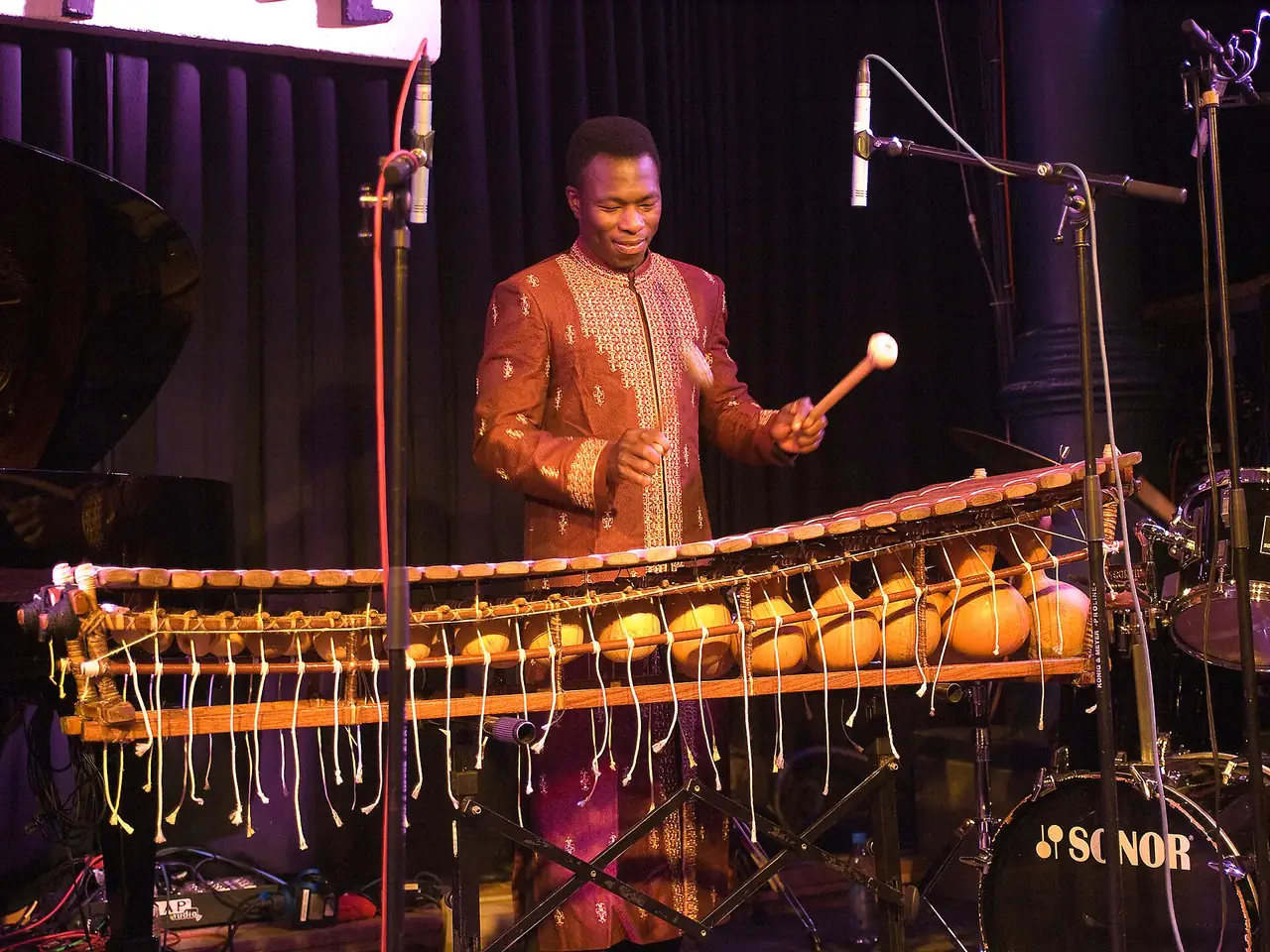
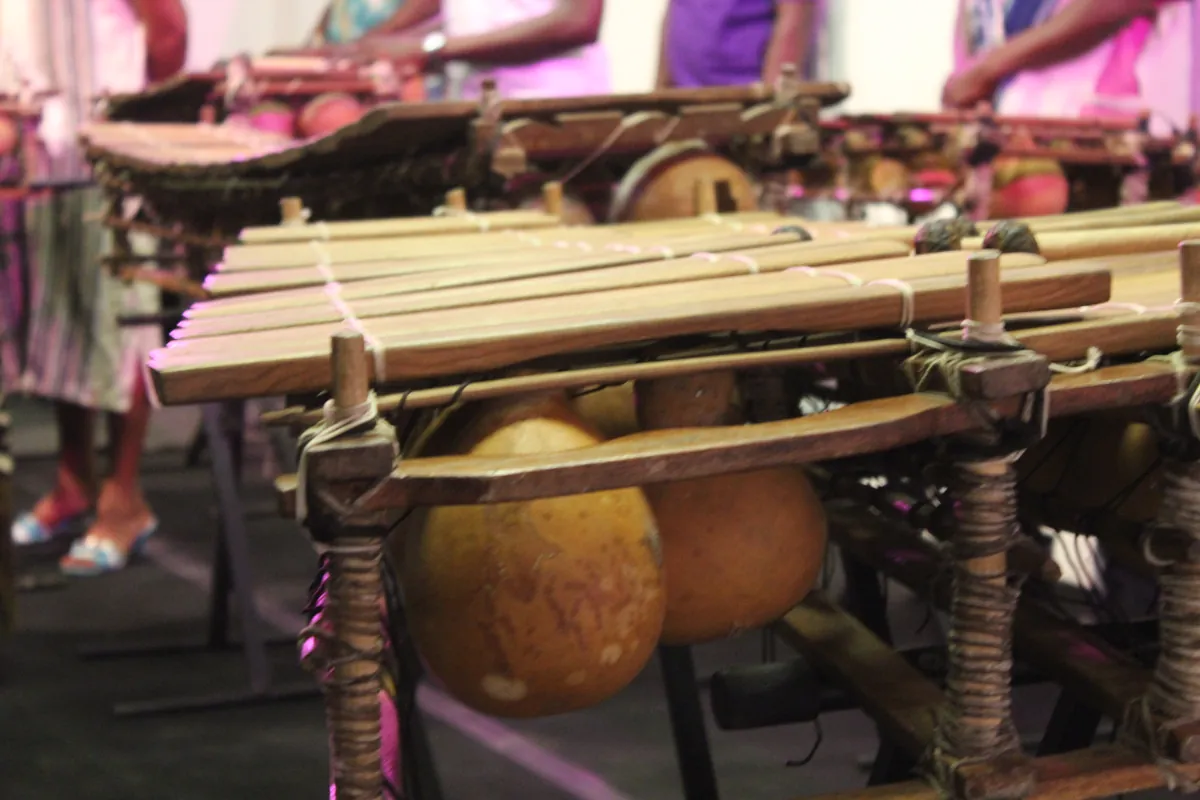
Strike a wooden key and you’ll hear a buzz that carries a long way. The secret hangs underneath: a row of hollow gourds. The balafon has accompanied Mande griots since at least the 13th century. In Senufo villages, it marks the rhythms of daily life. Listen to the instrument, see how it’s made and hear what three players do with those keys.
Instrument familyA xylophone with resonators. Each wooden key has a gourd hanging beneath it.
KeysUsually 17 to 21, carved from African rosewood.
Where it comes fromThe Mande and Senufo regions of Mali, Guinea, Burkina Faso and Côte d’Ivoire.
HeritageUNESCO listed the Sosso-Bala in 2008 and recognized Senufo balafon traditions in 2011 and 2012.
01
Start with a listen
In a garden in Bamako, Neba Solo plays the Senufo balafon alongside Benego Diakité on donso ngoni, the hunters’ harp. The two musicians recorded their album “A Djinn and a Hunter Went Walking” in this same garden. Here they are playing “Ba Ngolo.”
“Ba Ngolo” live, with Neba Solo and Benego Diakité. Released by Nonesuch Records in 2026.
02
How it’s made
Lay wooden keys of different lengths across a wooden frame and you have the beginnings of a balafon. The longest keys give you the lowest notes, the shortest the highest. The maker cuts them from African rosewood and dries them slowly over a low fire. Tuning each one takes a little more carving. Removing wood from the middle lowers the pitch. Taking it off the end raises it.
1Keys are cut from African rosewood. There are usually 17 to 21, arranged from lowest to highest.
2The wooden frame holds the keys above the gourds.
3Gourd resonators hang beneath the keys. The maker chooses one the right size to amplify each note.
4A thin membrane covers a small hole in each gourd. Its vibration gives the note its buzz.
5The mallets have rounded heads. The player holds one in each hand.
Look closely at a gourd and you’ll find a small hole covered with a very thin membrane. Makers once used silk from spider egg sacs. Today they often use cigarette paper or thin plastic film. Strike a key and the membrane beneath it vibrates. Players prize the buzz it adds to the note. It’s the sound that gives the balafon away as soon as you hear it.
Tuning varies from one region to another. You might hear four, five or seven notes to an octave. Each balafon is tuned for the music of the people who play it.
03
Eight centuries of history
Early 13th century
Soumaoro Kanté, king of Sosso, owns and plays the Sosso-Bala, the best-known balafon in Mande history. The Kouyaté griots of the Dökala family still care for the original instrument in a round earthen house in Niagassola, Guinea.
1352
The traveler Ibn Battuta visits the court of Mansa Sulayman, ruler of Mali. He sees the king’s interpreter striking an instrument made of reeds with small gourds underneath. His account is among the earliest written descriptions of the balafon.
2001 and 2008
UNESCO recognizes the cultural space of the Sosso-Bala as a Masterpiece of the Oral and Intangible Heritage of Humanity in 2001. In 2008 it adds the tradition to its Representative List.
2011 and 2012
UNESCO recognizes the balafon traditions of Senufo communities in Mali and Burkina Faso in 2011. In 2012, the listing expands to include Côte d’Ivoire.
2024
The listing grows to include the Indonesian kolintang, another family of wooden xylophones. The kolintang and the balafon now share an entry on UNESCO’s intangible cultural heritage list.
04
Two balafon traditions
The Mande balafon
Mali, Guinea, Senegal and the Gambia
For the Mande griots, or jeli, the balafon helps tell a family’s story. It accompanies songs recounting the epic of Sundiata, founder of the Mali Empire, as it has for centuries. In Niagassola, the guardian of the Sosso-Bala teaches children to play from the age of seven.
The Senufo balafon
Mali, Burkina Faso and Côte d’Ivoire
With five notes to the octave, the Senufo balafon accompanies everything from work in the fields to initiation rites. The Sikasso region of Mali is one of the centers of this tradition and hosts the international Triangle du balafon festival.
05
Players to listen to
Neba Solo
Mali, Senufo balafon
Neba Solo, born Souleymane Traoré, grew up in Nebadougou in the Kénédougou area of southern Mali. His father taught him to play. Today he’s one of the best-known voices of the Senufo balafon.
Listen to “Kene Balafons” and “A Djinn and a Hunter Went Walking,” with Benego Diakité (Nonesuch, 2026).
Born in Abidjan in 1969, Aly Keïta learned to play from his father, a Mande griot. He makes his own balafons. Now based in Berlin, he brings the traditional repertoire into his jazz playing. In 2022 he won the German Jazz Prize in the special instruments category.
Listen to “Akwaba Iniséné,” his first album, on Contre-Jour, and “Balafon Evolution” (2026) with his Berlin trio.
Lansiné Kouyaté comes from the Kangaba area, around 100 kilometers from Bamako. He plays a Mande balafon tuned to seven notes. Listen to how he finds room for it alongside a jazz quartet, then face to face with a piano.
Listen to “Kangaba” (2008), named for his home village, with David Neerman’s quartet. On “Kangaba-Paris” (2018), he plays a duo with pianist Jean-Philippe Rykiel.
In Ghana and Burkina Faso, Lobi and Dagara musicians often play the gyil in pairs. Look under its keys and you’ll see the same idea at work: a row of gourds. The Indonesian kolintang also has wooden keys and, since 2024, shares a UNESCO heritage listing with the balafon. What links most xylophones around the world is something you can hear. A wooden key rings out when you strike it.
07
Keep listening
These films show the balafon in the communities that play it. For a close listen to the instrument on its own, try Lassana Diabaté’s solo recording.
The balafon is a xylophone. You strike wooden keys with mallets. Its distinctive sound comes from the gourds suspended beneath those keys and the thin membranes that buzz as each note rings.
Where does the word “balafon” come from?
In Mande languages, “bala” names the instrument and “fô” means “to play.” Europeans may have combined the two words to form “balafon.”
How many keys does a balafon have?
Most have between 17 and 21. The Sosso-Bala in Niagassola has 20 keys and measures about a meter and a half in length.
What is a Senufo balafon?
It’s the five-note balafon played by Senufo peoples in Mali, Burkina Faso and Côte d’Ivoire. It accompanies important moments in village life. UNESCO recognized these playing traditions in 2011 and 2012.
Which balafon players should I try first?
For the Senufo balafon, start with Neba Solo. For the seven-note Mande tradition, try Lansiné Kouyaté. To hear how the instrument sounds in a jazz trio, listen to Aly Keïta. You’ll find recordings by all three above.