A low rumble that you can pick out in a second comes from a eucalyptus trunk hollowed by termites. In Arnhem Land in northern Australia, Yolŋu people call the instrument yiḏaki. Spend a little time with the music and the people it comes from before you pick one up.
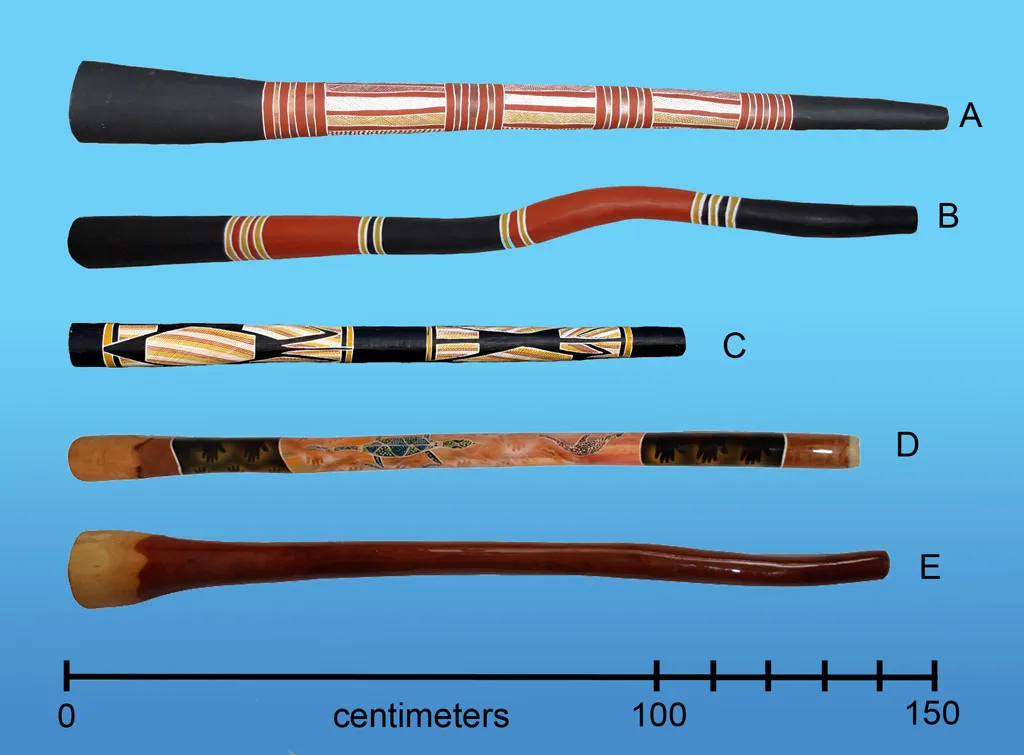
Five eucalyptus didgeridoos hollowed by termites. The top three are from Arnhem Land. Photo by Hmarin, via Wikimedia Commons, public domain.
FamilyA wind instrument. The player vibrates their lips to make it sound, much as a trumpet player does.
MaterialA termite-hollowed eucalyptus trunk, 1 to 3 meters long and often around 1.2 meters.
OriginsNorthern Australia. In Arnhem Land, Yolŋu people call it yiḏaki.
TechniqueCircular breathing lets the player take air in through the nose while the note keeps sounding.
01
Listen first
Meet Australian didgeridoo player William Barton at the Melbourne Recital Centre, where he was an artist in residence. First he talks about the instrument, then you get to hear him play it on its own.
“Contours of Songlines,” William Barton on solo didgeridoo. Filmed in 2019 and shared by the Melbourne Recital Centre.
02
How a didgeridoo is made
The maker starts by looking for a hollow tree. Termites eat away the dead heartwood inside certain living eucalyptus trees. The living wood around it repels them. What they leave behind is a natural tube with an uneven bore, part of what gives each instrument its sound.
Walking through the forest, the maker taps trunks, sometimes with the back of an axe, listening for one that sounds hollow, but not too hollow. Once a tree is chosen, the maker fells it, strips the bark, clears the inside and shapes the wood. Yolŋu makers most often use gaḏayka, a stringybark eucalyptus.
1The mouthpiece is carved from the wood itself by Yolŋu makers. Elsewhere, it often has a beeswax rim.
2The eucalyptus trunk is stripped of its bark. It measures 1 to 3 meters long.
3The bore is the uneven hollow left by termites. Its shape helps give the instrument its voice.
4The decoration is painted by hand. Some instruments are left plain.
5The bell is the wider end, where the sound comes out.
Many makers outside Yolŋu country add a ring of beeswax to the end that meets the lips. Yolŋu makers prefer a trunk whose natural hollow lets them carve the mouthpiece directly from the wood. The local bees don’t produce the kind of yellow wax that is easy to collect.
03
How the drone keeps going
To hear where the didgeridoo sound begins, think of what your lips do at the mouthpiece. They vibrate as you blow. That vibration produces the drone, the low, steady rumble you hear underneath the changes in sound.
Experienced players sustain the drone with circular breathing. As they breathe in through the nose, they use their cheeks to squeeze out air held in the mouth. The sound keeps going through the next breath.
Moving the tongue changes the color of the sound. A player can sing into the instrument too, or imitate Australian animals such as the dingo or the kookaburra while continuing to blow.
04
Roots in Arnhem Land
Before Europeans arrived, people played the didgeridoo only in the far north of Australia. Rock paintings showing players have been dated to roughly 1,000 to 1,500 years ago. The age of the instrument itself is still debated.
In northeastern Arnhem Land, Yolŋu people call it yiḏaki. Along with song, dance, painting and stories, it has a place in Yolŋu law and ceremony. There are dozens of other local names. In western Arnhem Land, for instance, you may hear it called mako.
The word “didgeridoo” came from settlers imitating the sound of the instrument. A spelling of it appeared as early as 1908 in the Australian newspaper the Hamilton Spectator: “did-gery-do.”
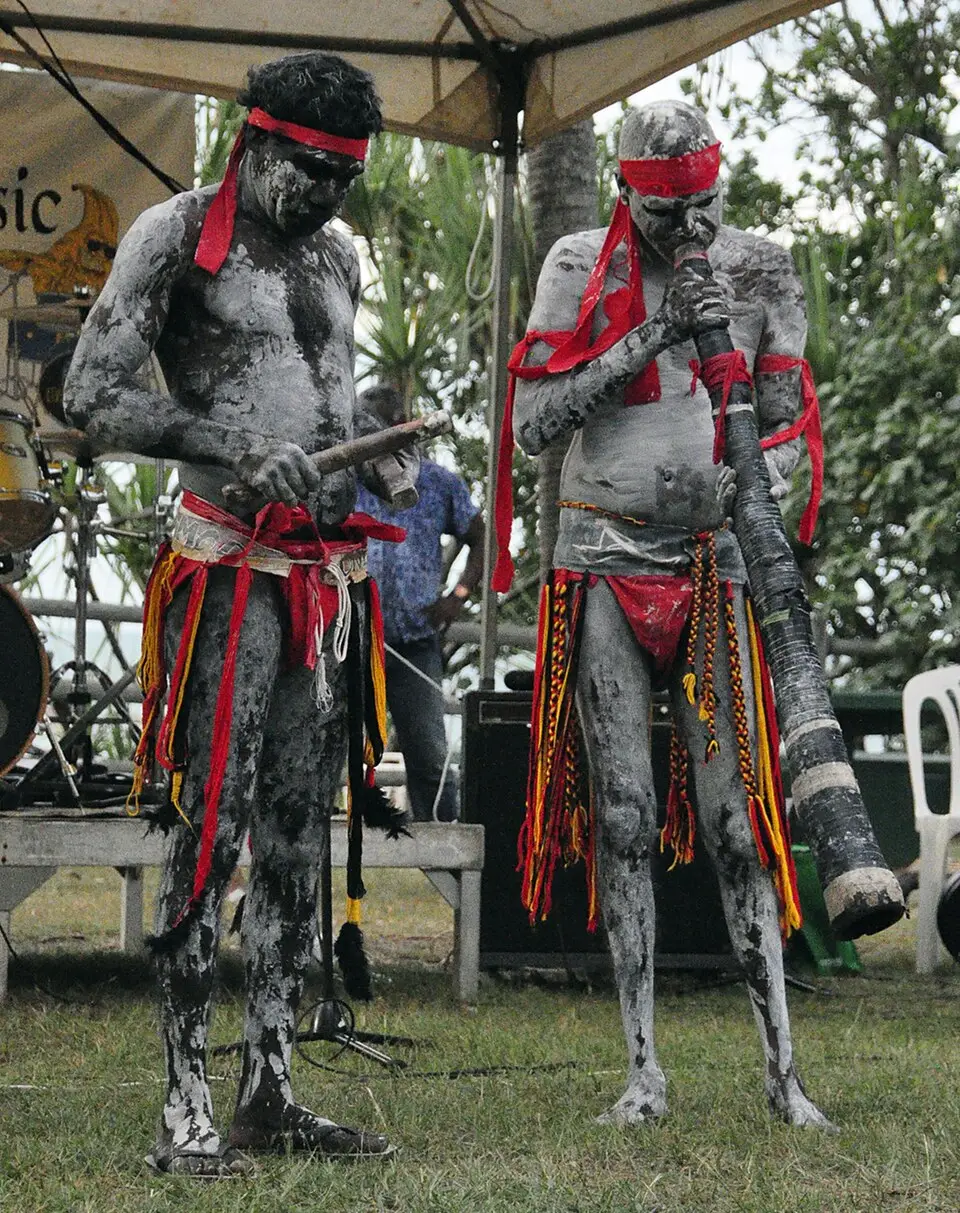
Didgeridoo and clapstick players from One Mob Different Country at the Nightcliff Seabreeze Festival in May 2013. Photo by Owen65, via Wikimedia Commons, licensed under CC BY-SA 2.0.
In Yolŋu communities, the yiḏaki is played primarily at ceremonies, including funerals and initiations. It usually accompanies singing, clapsticks and dancing. Solo playing is rare, and some yiḏaki are never played in public. Boys also play for fun, challenging one another with fast rhythms.
05
What to know before you play
Aboriginal and Torres Strait Islander readers are advised that this guide names a person who has died.
You can buy a didgeridoo around the world. The instrument still belongs to living traditions with their own customs. Here is how Yolŋu and other Australian sources explain them.
Who plays
Arnhem Land
Under Yolŋu law and custom, women do not play yiḏaki. Most Yolŋu men and women want to uphold that custom. YiḏakiStory, a resource created with Yolŋu people, leaves women from other cultures to decide for themselves, asking them to be mindful of the people around them. Customs vary from one community to another.
Names during mourning
Yirrkala
During mourning, Yolŋu people avoid saying the name of someone who has died and even words that sound like it. For a time around Yirrkala, people used mandapul in place of yiḏaki. Here we use “Mr Gurruwiwi” for the Galpu clan’s yiḏaki master who died in 2022, following the wording broadcaster NITV used with his family’s permission.
If you’re buying a didgeridoo, look for the maker’s name and where they come from. Ask the seller how the artist gets paid. The Indigenous Art Code logo is a helpful sign. Dealers choose to sign up to this code of conduct. In 2019 the Federal Court of Australia fined Birubi Art $2.3 million for selling Indonesian-made objects, including didgeridoos, as Aboriginal-made.
If you plan to record or make music using these traditions, Creative Australia publishes protocols for working with First Nations cultural heritage. First published in 2002, they have since been revised.
06
Meet the musicians
William Barton
Queensland, Australia
Barton, a Kalkadunga musician, grew up on a farm near Mount Isa. His uncle Arthur Peterson began teaching him the didgeridoo when he was about seven. At 17 he performed with the Queensland Symphony Orchestra. He has since played with the London and Berlin philharmonic orchestras.
Start with “Kalkadungu,” for didgeridoo and orchestra, which won the 2012 ARIA Award for Best Classical Album. On “Heartland” (2022), Barton plays with violinist Véronique Serret.
Yothu Yindi formed in 1986, bringing together Yolŋu musicians from around Yirrkala and non-Aboriginal musicians. The group plays guitars and drums alongside yiḏaki and bilma clapsticks. Its name means “child and mother.” In 1991 a remix of “Treaty,” sung in Gumatj and English, reached 11th place on the Australian chart. The band entered the ARIA Hall of Fame in 2012.
Start with “Tribal Voice” (1991), which includes “Treaty,” a song the band co-wrote with Paul Kelly.
The singer-songwriter grew up in Jan Juc, near Torquay. Onstage he surrounds himself with didgeridoos, slide guitars and percussion instruments he plays with his feet.
Start with “Food in the Belly” (2005) and “Spirit Bird” (2012), the album featuring “Follow the Sun.”
It’s a wind instrument from northern Australia. Traditionally, the player blows into a termite-hollowed eucalyptus trunk and vibrates their lips to make a low, continuous drone.
Where does the didgeridoo come from?
It comes from Aboriginal peoples of northern Australia. In northeastern Arnhem Land, Yolŋu people call it yiḏaki. The word “didgeridoo” came from settlers imitating its sound.
How do players breathe without breaking the note?
They use circular breathing. They take air in through the nose while their cheeks push out the air held in their mouth. This keeps the drone sounding as they take a breath.
Can women play the didgeridoo?
In Yolŋu tradition, women do not play yiḏaki, particularly in ceremonies. Yolŋu sources leave the decision to women from other cultures and ask them to consider who is present. Customs vary between communities.
How can I tell who made a didgeridoo?
Check the label for the artist’s name and where they come from. Ask the seller how the artist is paid, and look for the Indigenous Art Code logo. Be wary of a painted bamboo tube marketed as Aboriginal-made without naming the maker.