One piece of carved wood, a goatskin head, ropes pulled tight and two bare hands. That’s all it takes to play the djembe. It comes from the Manding peoples of West Africa. Today, you can learn to play it as far afield as Europe, the United States and Japan.
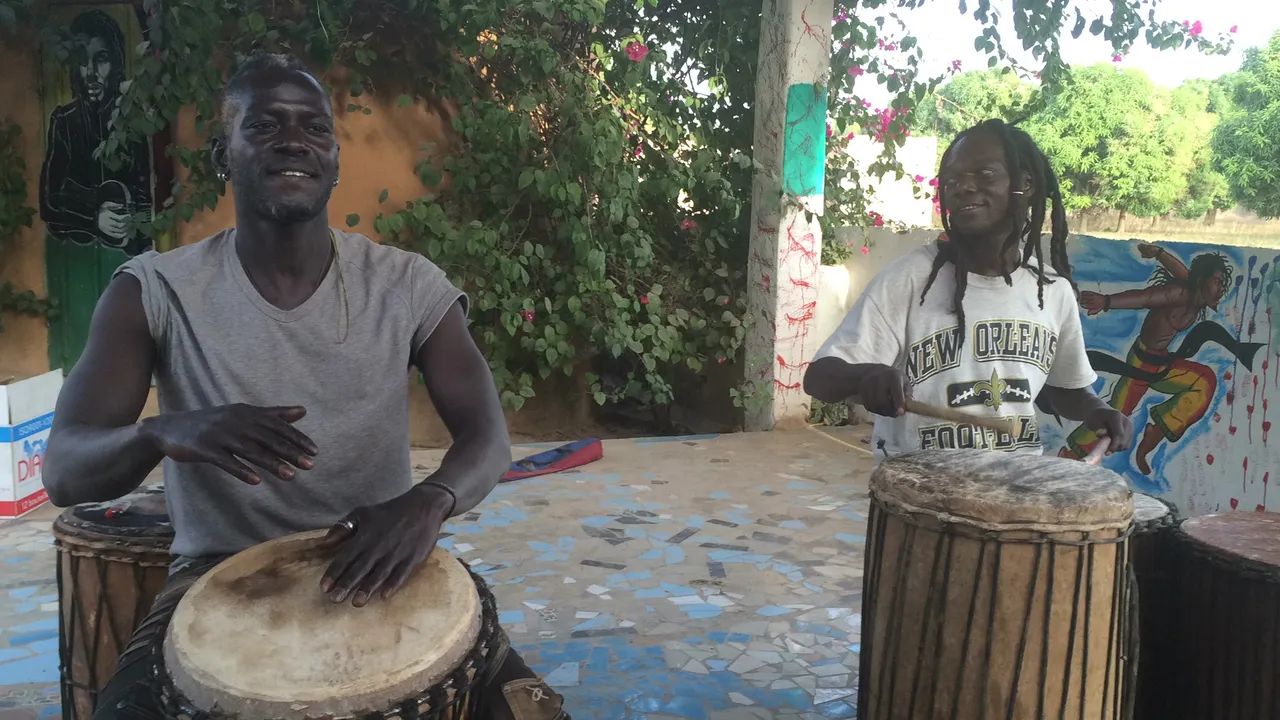
A djembe player and a dunun player. Photo by Pongsapak Kiatpreecha, Wiki Loves Africa 2016, via Wikimedia Commons, licensed under CC BY-SA 4.0.
FamilyA goblet-shaped drum played with bare hands.
MaterialsA shell carved from a single piece of wood, a head usually made of goatskin, and rope to pull it tight.
OriginsThe Manding peoples of Mali, Guinea, Burkina Faso and Côte d’Ivoire.
Three soundsBass, tone and slap, from lowest to highest.
01
Listen first
Start with Mamady Keïta. The Guinean djembe master is playing here with his group Sewa Kan at the 2009 Afrika Festival in Hertme, in the Netherlands. Give them a listen. Below, you’ll find out how a pair of hands can draw three different sounds from the same drumhead.
Mamady Keïta and Sewa Kan in concert, shared by Afrika Festival Hertme on its official channel.
02
How a djembe is made
Look at the shell from the side. A wide bowl tapers to a narrow waist, then flares out again at the foot. It looks a little like a mortar for pounding grain, which may be where the shape came from. The maker carves it from one piece of hardwood. Lenké is especially prized, though makers also use iroko, dugura and djalla. Without its rings, a djembe stands 58 to 63 cm tall and weighs 5 to 13 kg.
1The head is made from rawhide, usually goatskin.
2Three metal rings hold the head in place.
3Tuning ropes pull the head tight. Most are made of synthetic fiber today.
4The shell is carved from one piece of wood in the shape of a goblet.
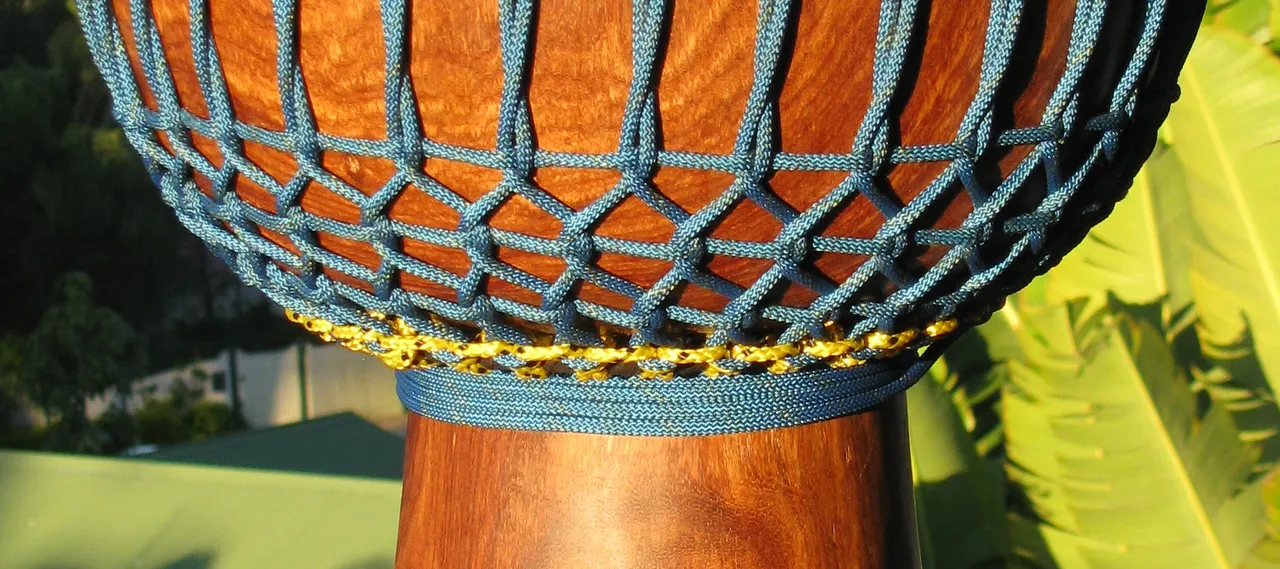
Two rings grip the skin at the top. To tune the drum, the player twists pairs of vertical ropes so they pull tighter, working around the shell one row at a time. This pattern is called the Mali weave. Each row adds a little more tension to the head.
Many players also attach one to four metal rattles, called sege sege, to the shell. They vibrate along with the drum.
03
Three sounds to listen for
A djembe player works with three basic strokes. Where the hands land matters as much as how they move.
Bass. The palm and fingers land flat in the middle of the head. This gives you the lowest note.
Tone. The fingers stay together and strike close to the rim. Listen for a full sound in the middle register.
Slap. The hand lands near the rim again, but only the heel of the hand and the fingertips touch the head. This gives you the highest sound of the three.
An experienced player can produce more than 105 decibels, about as loud as a jackhammer. There’s another way to describe a skilled drummer in the Manding tradition: they “make the djembe talk.” Their hands tell a story.
04
Manding roots
One Bambara explanation traces the drum’s name to the expression “Anke djé, anke bé,” meaning “everyone gathers together in peace.”
13th century
The djembe develops within the Mali Empire, founded by Soundiata Keïta. Its origins are linked to Manding blacksmiths known as the Numu. As they moved, they may have taken the instrument across West Africa.
1952
Fodéba Keïta founds Les Ballets Africains. The company introduces audiences far beyond West Africa to the djembe.
1958
After Guinea gains independence, President Sékou Touré makes the troupe the country’s first national ballet.
After 1984
Following Sékou Touré’s death, several djembe masters move abroad to teach. Mamady Keïta goes to Belgium and Famoudou Konaté to Germany.
1991
Mamady Keïta opens his school, Tam Tam Mandingue, in Brussels. The same year, Laurent Chevallier’s film “Djembefola” follows him back to his home village after 26 years away.
05
The djembe and the dunun
In Manding music, the djembe plays alongside the dunun. These cylindrical drums have a skin at each end and are played with a stick. They come in three sizes. The largest, the dundunba, sounds the lowest notes. The middle drum, the sangban, often plays the part that identifies the rhythm. The smallest, the kenkeni, holds the group together with a simple pattern. A player will often strike a bell called a kenken as well.
A typical group in Guinea has three djembes and three dunun. In Mali, a single djembe and a single dunun are often enough.
06
Other African drums
The sabar
Senegal, The Gambia and Mauritania
Sabar is the name of a drum, a dance and a celebration. The drummer stands, striking the head with one bare hand and a thin, flexible stick called a galan in the other. Sabars accompany births, weddings and wrestling matches. The tallest drum, the nder, leads the group. The mbëng-mbëng supplies the foundation for mbalax.
The talking drum
Senegal, Mali, Ghana and Nigeria
The player tucks this hourglass-shaped drum under one arm and strikes it with a curved stick. Squeezing the cords between its two heads changes the pitch, so the drum can imitate the rise and fall of a tonal language. Its names include tama in Wolof, dùndún or gangan in Yoruba, and kalangu in Hausa.
Farther south and east, the word ngoma means “drum” in Bantu languages and can also refer to the music and the dancing. In Burundi’s ritual dance of the royal drum, at least ten drums form a semicircle around a central drum. The number of drums is always odd. The dance welcomes distinguished visitors and marks celebrations. UNESCO added it to its list of intangible cultural heritage in 2014.
07
Meet the players
Mamady Keïta
Guinea, djembe
Mamady Keïta was born in 1950 in Balandougou, Guinea, near the border with Mali. At 14 he joined the Ballet National Djoliba. In 1979 he became its artistic director. He moved to Belgium in 1988 and founded Tam Tam Mandingue in Brussels. The school went on to open branches elsewhere in Europe, North America and Asia. He died in Brussels in 2021.
Start with “Wassolon” (1989), followed by “Hamanah” (1996), with Famoudou Konaté.
Born around 1940 near Sangbaralla in the Hamana region of Upper Guinea, Konaté was the djembe soloist with Les Ballets Africains from 1959 to 1985. He moved to Germany in 1988 and worked in Berlin, where the University of the Arts named him an honorary professor in 1996.
Start with “Rhythmen der Malinke” (1991) and “Guinée: percussions et chants malinké” (Buda Musique, 1998).
Born Mamadou N’Diaye in Dakar in 1930, he became a modern master of the sabar. In 1960 he took charge of Senegal’s national ballet as drum major. He played with Miles Davis, the Rolling Stones and Peter Gabriel, and led Les Rosettes, an ensemble of his daughters and granddaughters. UNESCO named him a Living Human Treasure in 2006. He died in 2015.
Start with “Djabote,” recorded in 1991 on Gorée Island with about 50 percussionists and released in 1994. Then try “Twenty-One Sabar Rhythms” by the Doudou Ndiaye Rose family (Honest Jon’s, 2022).
The djembe is a hand drum from the Manding world. Its companions, the dunun, are played with sticks. The sabar comes from Senegal and The Gambia. The tama is a talking drum, and ngoma is a word for “drum” in Bantu languages.
Is a djembe the same as a tam-tam?
In the strict sense, a tam-tam is a large suspended metal disc, similar to a gong. In everyday French, you may hear “tam-tam” used loosely for all sorts of African drums, including the djembe.
What is a djembe made of?
The shell is carved from a single piece of hardwood, preferably lenké, though makers also use iroko, dugura or djalla. The head is usually goatskin, sometimes antelope or cowhide. Ropes and three metal rings keep it under tension.
Which djembe players should I listen to?
Start with Mamady Keïta and Famoudou Konaté, both former soloists with Guinea’s national ballet companies. For sabar, try Senegal’s Doudou N’Diaye Rose. You’ll find recordings by all three above.
Sources
Djembe, English Wikipedia (construction, dimensions, strokes, etymology, origins and Les Ballets Africains), and Djembé, French Wikipedia (wood, hides, sounds and countries).