Twenty-one strings stretched above a large gourd, and just four fingers to set them ringing. For generations, the kora has accompanied Mande griots from Mali to the Gambia and Senegal.
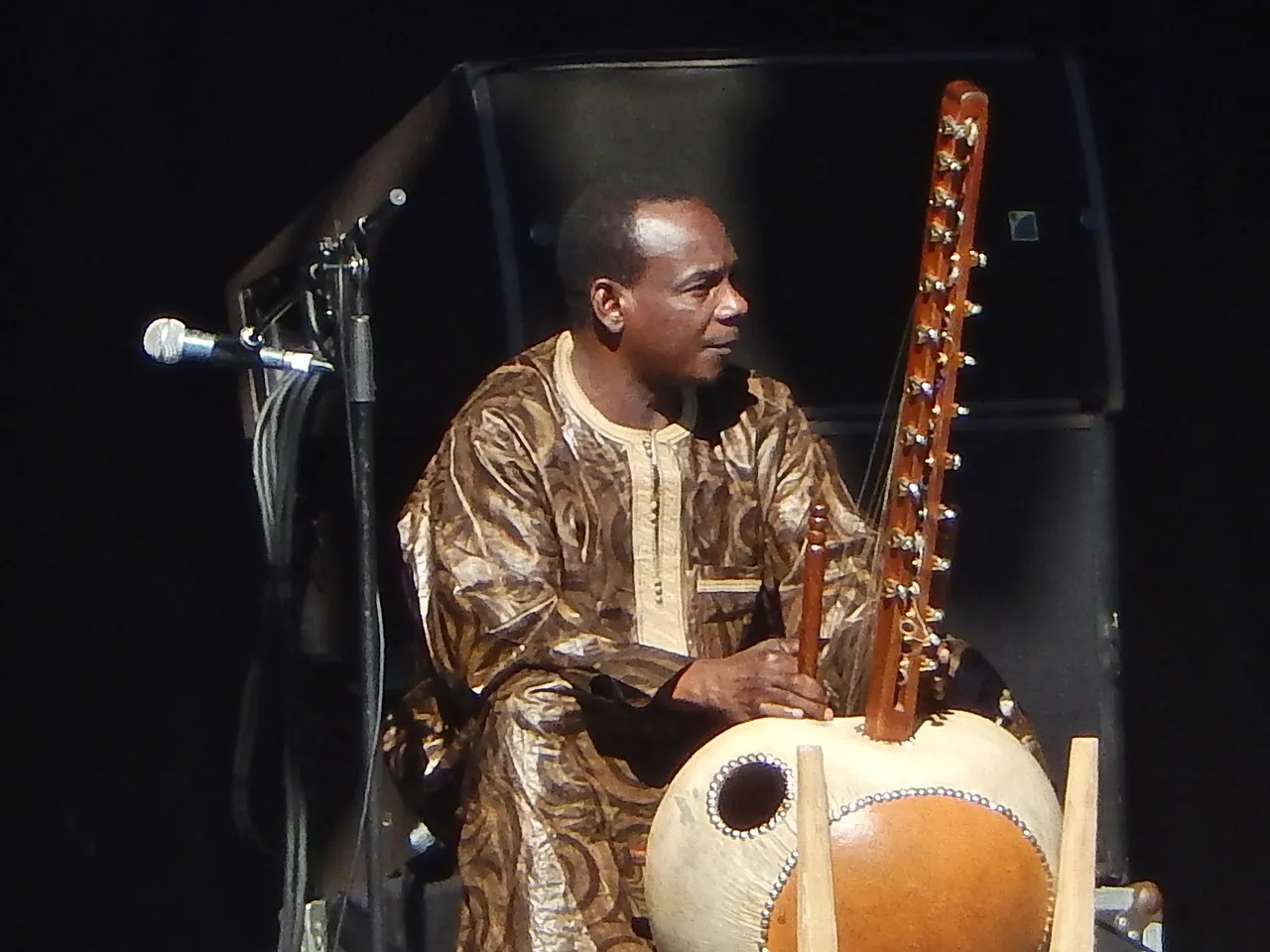
Toumani Diabaté at WOMADelaide in Australia, 2015. Photo by Michael Coghlan, Wikimedia Commons, licensed under CC BY-SA 2.0.
Instrument familyA harp-lute. Its plucked strings pass over a bridge that rests on a gourd.
StringsUsually 21. The left hand plays 11 strings, the right hand 10.
Where it comes fromThe Mande region of the Gambia, Senegal, Mali, Guinea and Guinea-Bissau.
PlayersGriots, also called jali, from families that have passed the kora from father to son.
01
Start with a listen
Can you follow the circling bass and the quick runs above it at the same time? In this live performance of “Cantelowes,” both come from Toumani Diabaté’s hands. The piece closes “The Mandé Variations” (2008), a whole album of solo kora. There’s no other instrument on the record.
Toumani Diabaté plays “Cantelowes” live at El Real Alcázar. Released by World Circuit Records.
02
How it’s made
Start with a gourd measuring 40 to 60 centimeters across and cut it in half. A kora maker stretches wet cowhide or goatskin across the opening and fixes it in place with upholstery tacks. A long hardwood neck passes through the gourd. The kora that belonged to Mamadou Kouyaté, now in New York’s Metropolitan Museum of Art, measures nearly 1.16 meters from end to end.
1Half a gourd forms the resonating chamber.
2Cowhide or goatskin is stretched over the gourd and tacked around its rim.
3The hardwood neck passes through the gourd and carries the tuning rings or pegs.
4The bridge rests on the hide. The tension of the strings alone holds it upright. It separates the strings into two rows.
5The strings usually number 21, with 11 on one side of the bridge and 10 on the other.
6The handgrips are two rods slipped under the skin. The musician holds on to them while playing.
Kora strings were once thin strips of cow or antelope hide. Most players today use nylon fishing line, though some use harp strings. Earlier players tuned the kora by sliding leather rings up or down its neck. Many instruments now have guitar-style tuning machines.
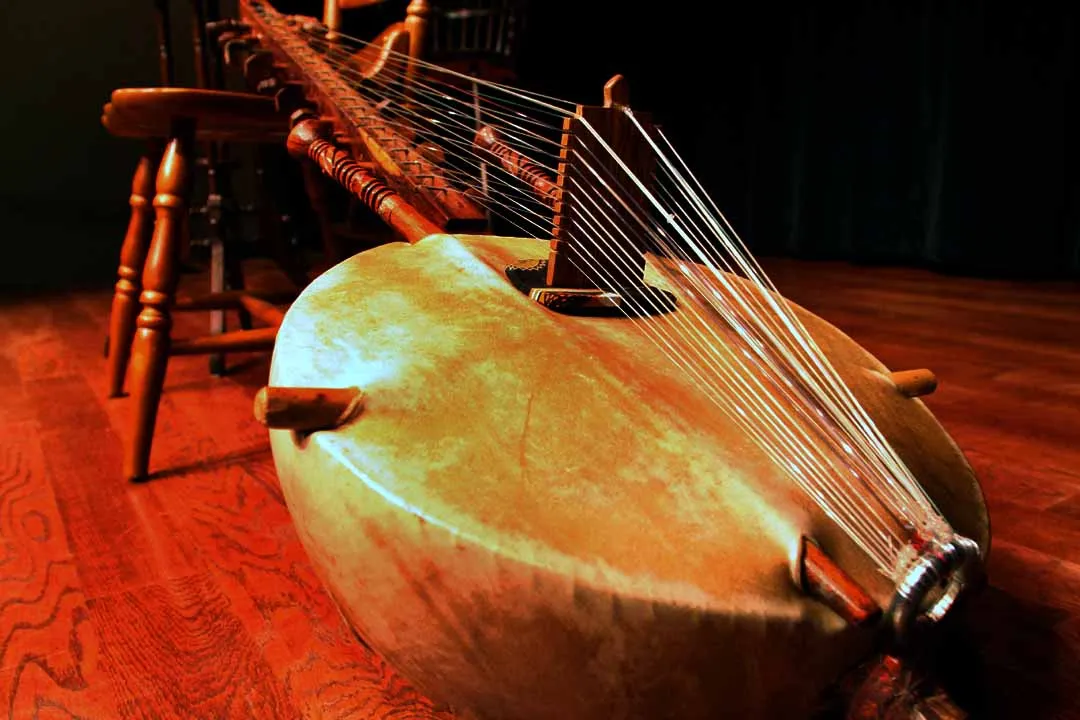
The hide, bridge and strings of a kora seen up close. Photo by Steve Evans, Wikimedia Commons, licensed under CC BY 2.0.
There’s room for variation in the design. In Casamance, in southern Senegal, some koras have as many as 25 strings. Seckou Keita plays a 22-string kora, and other musicians use instruments with even more.
03
How to play it
A player sits or stands with the kora out front. Both hands hold the grips, leaving the thumbs and index fingers free to pluck the strings on either side of the bridge. The thumbs generally carry the bass while the index fingers improvise the melody.
Kora players use two words for what you hear. The kumbengo is the repeating pattern that holds the piece together. The birimintingo is the improvised passage that rises above it. One musician plays both at once.
Mande griots use several tunings. Three you’ll hear about often are sila ba, the most common, tomora, used especially in the Gambia, and hardino, heard mainly in Mali and Guinea.
04
Where it comes from
In oral tradition
Griots trace the kora to the old kingdom of Kaabu, in what is now Guinea-Bissau, southern Senegal and the Gambia. Their accounts differ. In one, the warrior Tiramakhan Traoré takes the instrument from a female spirit in the caves of Missirikoro, Mali. In another, Mady Wouling Cissoko buys it from a djinn.
1799
Scottish explorer Mungo Park publishes an account of his travels in West Africa. He describes the “korro” as a large harp with eighteen strings. It’s the earliest known European reference to the kora.
1960
Senegal adopts its national anthem, with words by Léopold Sédar Senghor. The opening line calls on musicians to pluck their koras and strike their balafons.
1970
Sidiki Diabaté and Djelimady Sissoko record “Cordes anciennes,” often described as the first instrumental kora album.
1999
Their sons, Toumani Diabaté and Ballaké Sissoko, release “New Ancient Strings,” recorded in a single take in Bamako. You can hear the instrument pass from one generation to the next across the two records.
05
The griot families
The jali
Mali, the Gambia, Senegal and Guinea
A griot, or jali, is born into a family of musicians. Griots sing, tell stories and keep the history of their people. In his account published in 1799, Mungo Park described singers who recited the history of their country. It’s one reason so many kora players are also singers.
Musical families
Kouyaté, Diabaté, Konté and Cissokho
A small number of griot families have passed the kora down through the generations. Their names vary between languages: Diabaté can also be written Jobarteh, and Cissokho can become Suso. Toumani Diabaté and Sona Jobarteh are cousins. The Diabaté family’s musical tradition stretches back dozens of generations.
06
Players to listen to
Toumani Diabaté
Mali
Toumani Diabaté was born in Bamako in 1965, the son of Sidiki Diabaté. He played solo kora and led the much larger Symmetric Orchestra. His recordings with guitarist Ali Farka Touré won two Grammys, in 2006 and 2011. Toumani died in Bamako on July 19, 2024. His own son Sidiki, born in 1992, also plays kora.
Listen to “Kaira” (1988), his first solo album, then “The Mandé Variations” (2008). On “Toumani & Sidiki” (2014) he shares the recording with his son.
Ballaké Sissoko, born in 1968, was just 13 when he took his father Djelimady Sissoko’s place in Mali’s national instrumental ensemble. You can hear his ear for a musical partnership on “Chamber Music,” his album with cellist Vincent Ségal.
Listen to “Chamber Music” (2009) with Vincent Ségal. For Sissoko on his own, try “At Peace.”
Born in London in 1983 to a family of Gambian griots, Sona Jobarteh is the granddaughter of kora master Amadu Bansang Jobarteh. She became the first woman in this tradition to make a profession of playing the kora at a virtuoso level. She also sings and founded the Gambia Academy, a school in the Gambia.
Listen to “Fasiya” (2011), “Badinyaa Kumoo” (2022) and the single “Gambia.”
Born in Ziguinchor in 1978, Seckou Keita comes from the Cissokho griot family on his mother’s side. Now based in England, he plays a 22-string kora. His cousin Aliou Gassama built him a double kora in 2003. He has recorded several albums with Welsh harpist Catrin Finch.
Listen to “Clychau Dibon” (2013), with Catrin Finch, and “22 Strings” (2015), which won the Songlines award for best album from Africa and the Middle East.
It’s a West African string instrument played by Mande griots. A skin-covered gourd forms the body, a long neck passes through it and the plucked strings run over a bridge resting on the hide. Instrument specialists classify it as a harp-lute.
How many strings does a kora have?
Usually 21. The left hand plays 11, the right hand 10. Some koras in Casamance have as many as 25 strings, and some players use instruments with 22 or more.
How do you play the kora?
Hold the handgrips and pluck with your two thumbs and index fingers. The thumbs often play the bass, leaving the index fingers to play the melody and improvise.
Which country does the kora come from?
Its roots lie in the Mande world. Griots trace it to the old kingdom of Kaabu, in present-day Guinea-Bissau, southern Senegal and the Gambia. Today you’ll also hear the kora in Mali and Guinea.
How does a kora differ from a harp?
A kora can sound like a harp. Its strings are arranged in two rows between a long neck and a bridge resting on a skin-covered gourd. The player needs only four fingers to pluck them.
Sources
Kora, English Wikipedia (strings, construction, tuning, kumbengo and birimintingo, Kaabu, Mungo Park and Senegal’s national anthem). Kora, French Wikipedia (dimensions, hide, bridge, playing techniques, tunings, the Tiramakhan Traoré legend and griot families).