A kora and a cello on a rooftop in Bamako. A piano muted with felt. A guitar and a whisper of a voice. You can wind down to musicians playing slowly and softly, with hardly any lyrics. Below, you’ll find what the research says, albums to try, and a few simple tips for bedtime.
Ballaké Sissoko and Vincent Segal at the Skrzyżowanie Kultur festival in Warsaw. Photo by Philippe Salgarolo, Wikimedia Commons, licensed under CC BY-SA 4.0.
TempoSlow. The Sleep Foundation suggests around 60 to 80 beats per minute.
LyricsFew or none. Tracks on sleep playlists are more likely to be instrumental than music in general.
VolumeLow, with a small speaker in place of headphones.
The researchCochrane reviewed 13 studies involving 1,007 adults in 2022.
01
Listen first
At dusk one January evening in 2015, Ballaké Sissoko, from Mali, and Vincent Segal, from France, played on the roof of Sissoko’s home in Bamako. The house overlooks a quiet street in Ntomikorobougou, “the neighborhood of the old tamarind tree.” The two often played there for hours after dark. Much of their album “Musique de nuit” comes from a session recorded on that same rooftop.
“Diabaro” (live instrumental session), performed by Ballaké Sissoko and Vincent Segal and released by NØ FØRMAT! in 2015.
Segal pictured the whole neighborhood listening to the kora and cello and drifting off like a child. The next day, neighbors told the pair they had heard the musicians’ whispers in their dreams.
02
What the research says
In 2022, researchers from the Cochrane network reviewed 13 studies on listening to music among adults with insomnia, covering 1,007 people. Participants listened to recorded music for 25 to 50 minutes a day. The studies lasted between three days and three months.
The researchers found moderate-certainty evidence that music probably improves how people rate their sleep quality. They had less confidence in the evidence on how long it takes to fall asleep or how long people stay asleep. None of the studies reported any adverse effects.
For everyday listening, a favorite record can give you a quiet stretch before bed. It isn’t a treatment for insomnia.
03
What makes music gentle
In 2023, a team at the Center for Music in the Brain at Aarhus University in Denmark analyzed 225,626 tracks from 985 sleep-related Spotify playlists. Compared with music in general, sleep music tends to be calmer and slower. It’s also more likely to be instrumental or played on acoustic instruments. There’s still plenty of variety. The researchers found six distinct groups, including some with faster, more energetic tracks.
What to look for
According to the sources in this guide
The Sleep Foundation suggests a slow tempo of around 60 to 80 beats per minute and notes that there’s no consensus on what works best. Try acoustic instruments, few or no lyrics, and a volume low enough to feel comfortable.
What can get in the way
According to the Sleep Foundation
Some tracks stir up strong emotions. Choose music that feels neutral or makes you feel good. Keep the volume low and take earbuds out before you fall asleep.
04
An eight-hour lullaby
Max Richter wrote a piece for the night itself. “Sleep” runs for more than eight hours. Released in 2015 by Deutsche Grammophon, it brings together piano, cello, violas, violins, organ, soprano, and electronic sounds across 31 slow sections. “It’s an eight-hour lullaby,” he explains. While writing it, he consulted American neuroscientist David Eagleman about what the brain does during sleep.
The first full performance took place in the Wellcome Collection’s Reading Room in London, overnight on September 26 and 27, 2015, from midnight to 8 a.m.. BBC Radio 3 broadcast it live while the audience slept at the venue. A one-hour version, “From Sleep,” came out the same year.
05
Albums for bedtime
Ballaké Sissoko and Vincent Segal
Mali and France, kora and cello
Born in 1968, Ballaké Sissoko plays the kora, a 21-string West African harp. Cellist Vincent Segal was born in Reims in 1967. Both albums are gentle duets. You hear two string instruments answering each other without rushing.
Listen to “Chamber Music” (No Format!, 2009) and “Musique de nuit” (No Format!, 2015).
The guitarist from Niafunké (1939 to 2006) and the kora master born in Bamako (1965 to 2024) recorded together at the Hôtel Mandé on the banks of the Niger River. The album won the 2006 Grammy for Best Traditional World Music Album.
Listen to “In the Heart of the Moon” (World Circuit, 2005).
The German pianist was born in 1982 and is based in Berlin. He wanted to play late at night without disturbing his neighbors. He placed a thick layer of felt in front of his piano strings and played with a light touch. The microphones sat so close to the strings that they picked up his breathing. The felt gave the album its name.
Listen to “Felt” (Erased Tapes, 2011), recorded at night in his Berlin studio.
João Gilberto was born in 1931 in Juazeiro, in the state of Bahia, and died in 2019 in Rio de Janeiro. In 1973, he recorded a stripped-down album in New York with his voice, classical guitar, and a little percussion. Close microphones give it an intimate sound. The album opens with “Águas de Março” by Tom Jobim.
The British composer and pianist was born in Hamelin, Germany, in 1966. He wrote “Sleep” for people to hear as they slept. You can start with the one-hour version.
Listen to “From Sleep” (Deutsche Grammophon, 2015), then “Sleep,” the full version.
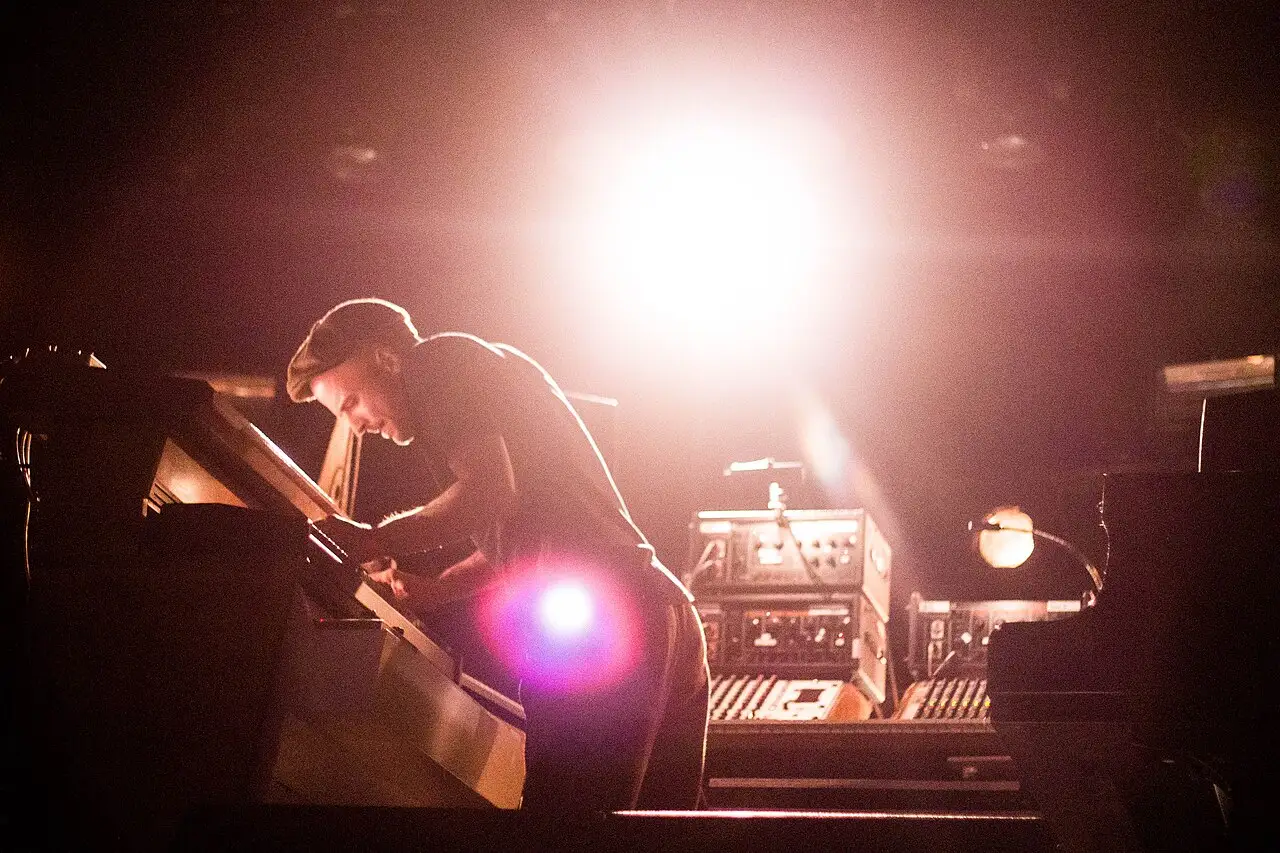
Nils Frahm at the Haldern Pop Festival in Germany, August 2018. Photo by Martin Schumann, Wikimedia Commons, licensed under CC BY-SA 4.0.06
A few bedtime tips
Set a timer. On Spotify, open the three-dot menu on the Now Playing screen to find the sleep timer. You can choose a time starting at 5 minutes or let the current track finish. On iPhone, set a timer in the Clock app, tap “When Timer Ends,” then choose “Stop Playing.”
Turn down the volume. Keep it just loud enough to hear. Use a small speaker by your bed so you can take your headphones off before you fall asleep.
Make it a routine. The Sleep Foundation suggests a bedtime routine that gives you time to wind down. Playing the same album at the same time can become your cue.
Play a whole album. That way you can avoid the abrupt changes that come with shuffle.
07
Further reading
Read the sleep studies or find out how Richter’s overnight performance worked.
Tracks on sleep playlists typically feature a slow tempo, a calm sound, few or no lyrics, and acoustic instruments. Try “Chamber Music” by Ballaké Sissoko and Vincent Segal or “Felt” by Nils Frahm.
Does music really help you sleep?
The 2022 Cochrane review concluded that adults with insomnia probably rate their sleep quality higher after listening to music. The evidence is weaker for how long it takes to fall asleep. If you’ve been sleeping poorly for a long time, talk to a doctor.
Should you leave music on all night?
You don’t have to leave it on. Use the sleep timer in Spotify or the timer in the iPhone Clock app to stop playback. Keep the volume low and take your headphones off before you go to sleep.
What’s a gentle song to play at bedtime?
If you’d like to hear singing, look for a voice that barely rises above a whisper. The 1973 album “João Gilberto” is a good place to start, with just a voice, a guitar, and a little percussion.
What tempo should I look for in sleep music?
The Sleep Foundation suggests a slow tempo of around 60 to 80 beats per minute and notes that there’s no established consensus. Go with what feels calming to you.