"Knowledge is the only wealth you can spend in full without diminishing it at all," A. HAMPATÉ BÀ
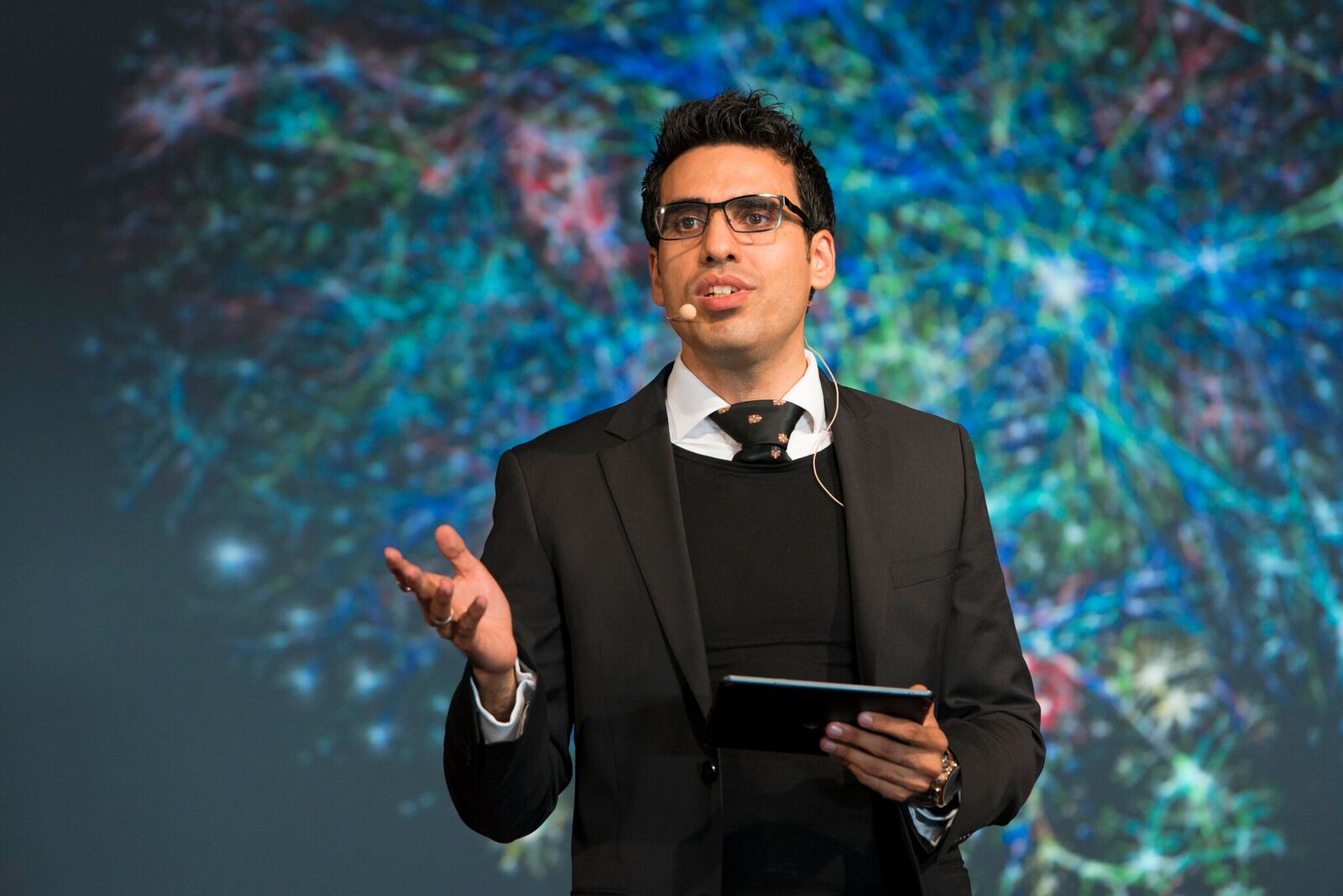
Born in 1986, Dr. Idriss Aberkane is a lecturer at Centrale-Supélec, a former intern in the University of Cambridge's Department of Experimental Psychology, a researcher at Polytechnique, an Affiliate Scholar at Stanford University's Kozmetsky Global Collaboratory, a professor of knowledge economics in the MBA program at Mazars University, and an ambassador for the Campus des Systèmes Complexes Unitwin/Unesco. He's a champion of the knowledge economy. And of biomimicry.
In a talk, Idriss Aberkane takes up the question of why we should pursue a knowledge economy. His answer is that "economic growth is based on raw materials, so there's a mathematical contradiction between finite raw materials and infinite growth." He goes on to explain that if we want economic growth to continue indefinitely, it makes sense to base it on knowledge, which is itself infinite.
Three rules govern this economy.
- Exchanges are positive-sum. If I share what I know, I still have it, and others benefit from it.
- Exchanges aren't instantaneous. Passing on knowledge takes time.
- Knowledge combines in nonlinear ways. When you bring two pieces of knowledge together, you always create a third.
Nature is the largest storehouse of knowledge on Earth. It's a library with 4 billion years of research and development ahead of it. Read it instead of burning it.
Idriss Aberkane adds that "biomimicry fits into this framework of the knowledge economy." So what exactly is biomimicry?
In fact, "biomimicry is the science that says nature is a library. Read it instead of burning it. Nature is actually high-tech." More precisely, as Idriss Aberkane explained in May 2016 at a 2016 talk on the knowledge economy at parc Galea (Taglio-Isolaccio) in Corsica, "Biomimicry is the art of seeing nature as a source of knowledge instead of a source of raw materials. It's a direct application of the knowledge economy, which tells us that knowledge is infinite. So if we shift from seeing nature as a source of finite raw materials to seeing it as a source of knowledge, the conflict of interest between growth and nature disappears." He drove the point home. "Nature is the largest storehouse of knowledge on Earth. It's a library with 4 billion years of research and development ahead of it. Read it instead of burning it."
Biomimicry and industry. The blue economy is "the application of biomimicry to industry. Imagine a world without waste. That world exists in nature. When leaves fall from trees, no one sets up a collection system. In nature, there's no waste because nature produces in cycles. We produce in a straight line." As Belgian industrialist Gunter Pauli says, "It's up to our factories to produce the way nature does. Nature is under no obligation to produce the way our factories do. If we do that, we'll be much more profitable, and there'll be no more waste."
To learn more, explore Idriss Aberkane's blog
By Fabien Salliou, NLP practitioner