Dominique Peter, drummer for the Lyon dub group High Tone, releases his first solo album, "Le Triomphe du Chaos," on October 2. Recorded in Bamako with Malian musicians, the album is part of an artistic project called "Midnight Ravers" that also includes a sketchbook by Emmanuel Prost. It's a journey in sound and images through an enchanting world between tradition and modernity.
Le Triomphe du Chaos review
This is the kind of project you wish you could hear and look at more often. By bringing music and drawings together, "Midnight Ravers" gives you two ways into Africa. The album has eight tracks. Some are entirely instrumental, like the airy "Same Pollution," "Smoky Place" and "Ride on," where the crystalline sound of Manou Diabaté's kora blends with more urban electronic sounds. Other tracks give the vocals plenty of room. You get swept up in the melancholy "Don’t let me down," where Rokia Traoré's young backing singer Fatima Kouyaté sings about the friends you leave behind. Another real standout is "Musical Stampede," with Cheik Sirima on vocals calling on the Malian people to reunite.
Audio file
You feel it every time. The emotion comes from that distinctive, mysterious atmosphere, created by layers of electronic sound that echo the traditional instruments. However much these sometimes very urban sounds are shaped and manipulated, they never take away from the purity of a kora, a flute, or the n'goni (a plucked string instrument).
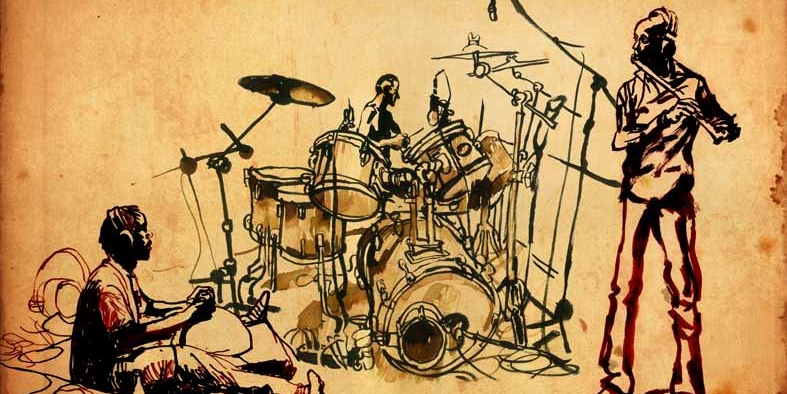
It's an often dreamlike journey to Africa, into Dominique Peter's world, and into yourself. There's a soul to this album, and there are stories told at times without words or through drawings. That's where Emmanuel Prost's talent deserves recognition. The illustrator, who also worked on the excellent comics series "Les autres gens," captured the waiting during long studio sessions and the musicians' concentration, as well as the warmth of Bamako's streets, their colors, their frenzy, and their gentleness. Better than a photograph, his imperfect yet assured lines and loosely sketched scenes let you share in the Malian adventure of these two men from Lyon.
Midnight Ravers, an interview with Domnique Peter
Culturebox: What made you want to put this project together in Mali with local musicians?
Dominique Peter: I've been a fan of reggae and dub for fifteen years (dub is a style of reggae based entirely on electronic effects), and we love traditional music in High Tone. So there was a natural connection. But it also came from some very personal things. Around that time, I lost several people close to me. Malian music, especially Manding blues, moved me and helped me get through those difficult times.
I wanted to express things in a different way and go somewhere people didn't expect me to go. High Tone's music is fairly "cold" and relies more on sampling. For this project, I wanted to get back to working with people who really play.
I'm also lucky to know Manjul, a reggae and dub artist who has lived in Mali for about ten years. He became a producer and set up a studio. Thanks to him, I got to meet some exceptional musicians. He's become such a central figure there that it's hard to go around him.
Why did you bring illustrator Emmanuel Prost into the project?
I really wanted to do something new. I love drawing, and I feel like we're surrounded by more photos and videos than we can take in… I wanted to get back to something "primitive," and Emmanuel's drawings have that quality. He knows how to capture the mood and the moments that really stand out, and he's fast!
Before you went, did you have a clear idea of what you wanted to do with the Malian musicians?
No, I wanted to take things as they came. It was a gamble, and I had no idea what would come out of it. It was only when we got back from the trip, which lasted three weeks, that Emmanuel and I realized how much we had gathered, him in drawings and me in sounds.
I already had 8 rough tracks, simple pieces with no frills so the artists could bring as many of their own ideas as possible. Once I got there, I played them for the Malian musicians. I was blown away because they jumped right in. They have a real curiosity and generosity. We worked with some top musicians, and above all, we met some wonderful people. We played during the day, and at night we'd go to bars in Bamako to see the musicians perform live. That's why we called the project "Midgnigt Ravers" ("ravers" means "partygoers," editor's note).
After making all this together, you went back to Paris to work alone in the studio with all that "material." How did you go about it?
It was hard because I had to make choices! I had a lot to listen to and sort through, and I had to find a rhythm and pick out a chorus. The quality was exceptional. It took two months to go through the raw recordings, and I spent the summer of 2012 mixing… I had to reshape the tracks and find the right arrangements. Sometimes I couldn't bring myself to tinker with the tracks anymore because they were so beautiful. That's why I left in long stretches of kora.
In the end, what did you get out of the project?
I opened a door and had no idea how much lay behind it. What surprised me was how much room the project took up in my life. I think I needed to see this adventure through. This crazy project turned into an exploration of myself, my emotions, life, death, love, and friendship. It nourished me personally.
Dominique Peter is currently recording High Tone's sixth album, due out in March 2014.
"Le Triomphe du Chaos" (Irfan Le Label) comes out October 2. The album is also coming out on vinyl with a booklet of drawings.
Malian musicians who contributed to the album
Cheick Dialo (flute)
Madou "Sidiki" Diabaté (kora. His father is none other than Sidiki Diabaté, considered the king of the kora.)
Fatim Kouyaté
Chick Sirima
Samba Diabaté (guitar)
Also Fodé Kouyaté and Lamine Tounkara for the drum and dumdum recordings, and Assaba Dramé
Source: http://culturebox.francetvinfo.fr/