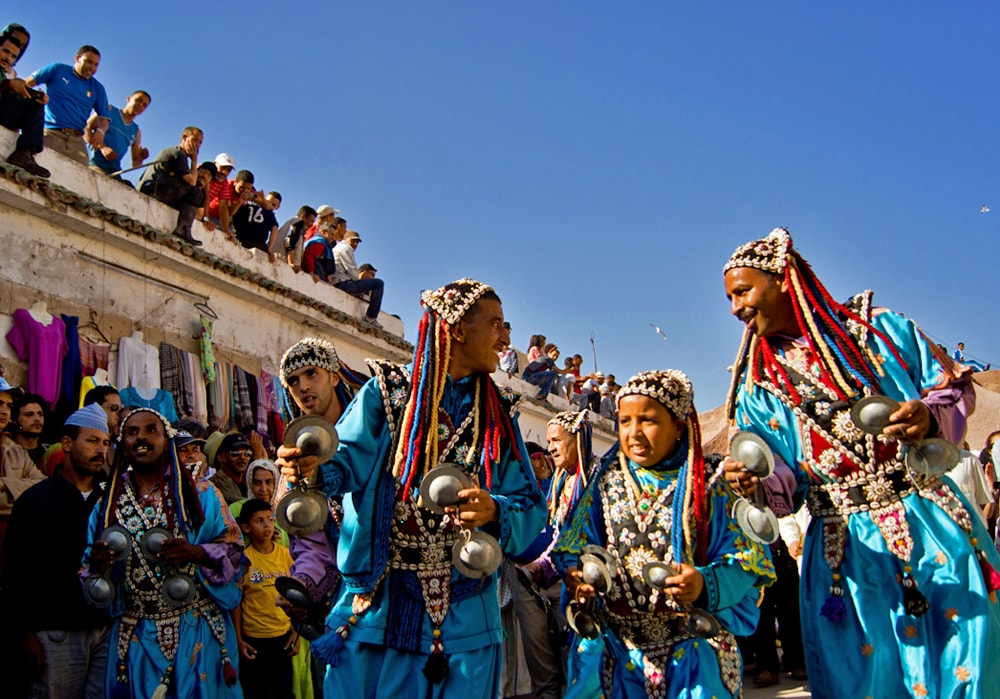
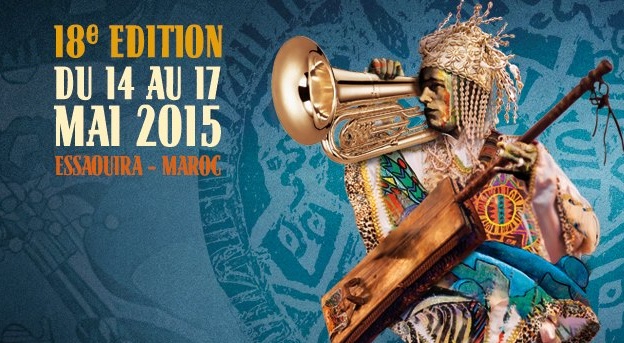
Hisham Aïdi, author of Rebel Music : Race, Empire and the New Muslim Youth Culture and a teacher at Columbia in the United States, studies the role of music culture and the music industry in the global war on terror and in resistance to authoritarian regimes in North Africa. The topic came up at a forum on diasporas organized by Morocco's Comité national des droits de l’homme alongside the Festival gnaoua et des musiques dumonde d’Essaouira, held May 12 through 15. Nearly 400,000 people took part in the 19th edition of the event, which began in 1998 to celebrate traditional Gnaoua music. In Morocco, Gnaoua is the name given to descendants of enslaved people from sub-Saharan Africa who were taken to the Maghreb through the Arab slave trade in Black Africa between the 8th and 19th centuries.
In your book, you often talk about the "politics of fusion." What do you mean by that?
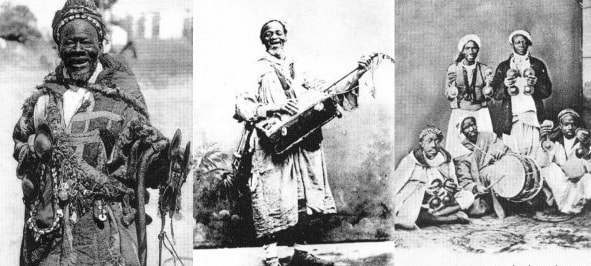
Hisham Aïdi: It all starts in the 1960s, when Black Americans like jazz musician Randy Weston discover how much their musical culture has in common with Gnaoua music. You can see that kinship in the resemblance between the bass and the sintir (also called the guembri, a kind of three-stringed lute played by Gnaoua musicians). For them, blending the two genres became a way to reconnect with their roots and feel a sense of communion with them. Musical fusion became a way to reconcile the African diaspora, Black Africa, and North Africa.
Has this fusion become a tool for Moroccan diplomacy?
Moroccan officials realized that the history of Gnaoua culture makes it easy to connect with the wider world. In a sense, it's a way to blend with the world beyond Morocco. Today, you can run into the U.S. ambassador to Morocco at the Festival d’Essaouira. In 2011, as protests rocked the region, the Moroccan government sent Gnaoua musicians like Mahmoud Guinea on a tour of the United States. Over time, Gnaoua culture has become the musical face of Morocco, taking the place of Arab-Andalusian music, a deeply classical style that was by far the most prominent after independence.
https://www.youtube.com/watch?v=UIwDKkiDPOg
Could Gnaoua music, with its largely sub-Saharan influences, be the music of a "new Moroccan nationalism" separate from the Arab world?
You have to be careful here. The identity embraced by the young people who flock to the Festival d’Essaouira is still a minority view. But in questioning the prevailing view, they're beginning to shape a more inclusive form of nationalism. Young people are looking to reconnect with Africa and questioning the idea of a single Arab identity promoted during the reign of Hassan II. Everyone can see this postcolonial shift in identity. Today, you can see it even in Morocco's new Constitution, adopted in 2011, which gives more room to the other cultural traditions that have shaped Morocco alongside its Arab identity.
Is there a risk that Gnaoua culture could be used to serve other agendas?
No, that's too strong a way to put it. For Morocco, the festival and the genre as a whole are good for tourism. They give people a positive impression of the country. In Western countries and in the Maghreb alike, all Sufi cultures are promoted as part of efforts to counter terrorism and, more broadly, Salafist rhetoric. But remember that a group like Gnawa Diffusion made a name for itself in part with songs against U.S. President George W. Bush. Young people see this music as challenging dominant narratives, including Islamist, racist, and pan-Arabist ones.
Could Gnaoua music play a role in the fight against racism in Morocco?
Absolutely. Like Black Americans decades ago, young people in the Maghreb are returning to their roots through Gnaoua music. They're rediscovering the Black part of their history and heritage. It's a genre and a culture that can bring people together, show how Morocco is connected to Black Africa, and help Moroccans connect with their continent.
Interview by Jules Crétois (contributor to Le Monde Afrique, Marrakech)
Learn more at http://www.lemonde.fr/afrique/