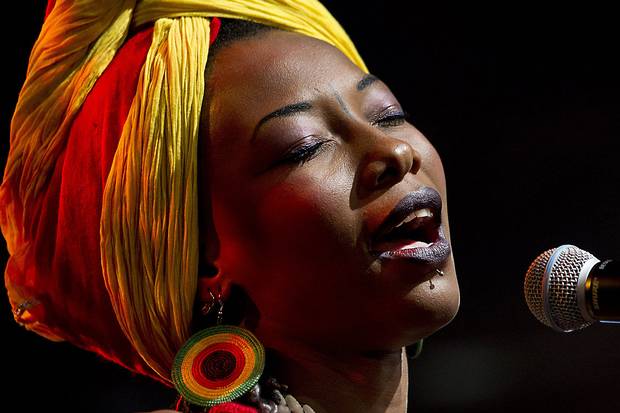
With Aimelody, you can discover one of Africa's greatest folk singers and most remarkable actors, an artist who has always fought for her freedom. Fatoumata Diawara was born in 1982 in Côte d'Ivoire to Malian parents. She started dancing in her father's troupe as a child and found great success performing the flamboyant didadi dance from Wassoulou, her ancestral homeland in western Mali. As a teenager, her independent streak led her to refuse to go to school, so her parents decided to send her to live with one of her aunts in Bamako, following an African tradition. She wouldn't see her father or mother again for nearly ten years.
Some time after she arrived, Fatou found herself on a film set, looking after the baby of her aunt, who was an actor. Taken with her beauty, the director gave her a line in le Pouvoir des femmes. This led Cheikh Omar Sissoko to give her one of the lead roles in his 1999 film La genèse. She acted alongside Sotigui Kouyaté, who became a guiding figure in her career.
At eighteen, Fatou went to Paris to act in Sophocles' Antigone, directed by Kouyaté. After touring with the troupe, she returned to Mali in 2001 to shoot Sia, playing the title role in the story of a legendary West African woman. The film was a phenomenal success in many countries. For many people in Mali, Guinea, Senegal, and Burkina Faso, Fatou IS Sia. But even as the offers poured in, her family wanted her to settle down and get married… Fatou was then forced to announce live on television that she was giving up acting.
In 2002, the director of the Royal de Luxe company came to Bamako to offer her a role in his new show. But in Mali, an unmarried woman had no more rights than a minor, and her family refused to give her the permission she needed. After thinking it over, Fatou decided to run away and managed to board a plane, narrowly escaping the police her family had sent after her for "kidnapping."
With Royal de Luxe, Fatou performed all over the world. During rehearsals and quiet moments, she liked to sing softly backstage. When the director heard her, he soon had her singing in the shows. Encouraged by the audience's response, she began performing in Paris clubs between tours. That's where she met Malian musician and producer Cheikh Tidiane Seck, who brought her back to Mali to sing backing vocals on the albums he was producing for Oumou Sangaré (Seya) and Dee Dee Bridgewater (Red Earth). Fatou also joined the tours.
Back in France, with encouragement from Rokia Traoré, who also urged her to play guitar, Fatou played Karaba in the musical Kirikou et Karaba. She recalls with a smile, "A Malian girl with an acoustic guitar was both wonderful and bold. Why should the guitar be just for men?" So Fatou taught herself to play guitar and began writing songs. That's when she realized music was her true passion and decided to devote herself to it fully. She recorded demos, singing and playing every instrument herself. Oumou Sangaré introduced her to the World Circuit label, and recording for her first album could begin…
Between sessions, Fatou still found time to take part in Damon Albarn's Africa Express project and sing backing vocals on albums by Cheikh Lô and the Orchestre Poly-Rythmo de Cotonou, as well as work on AfroCubism and Herbie Hancock's Imagine project.
Source: Official biography, www.fatoumatadiawara.fr/