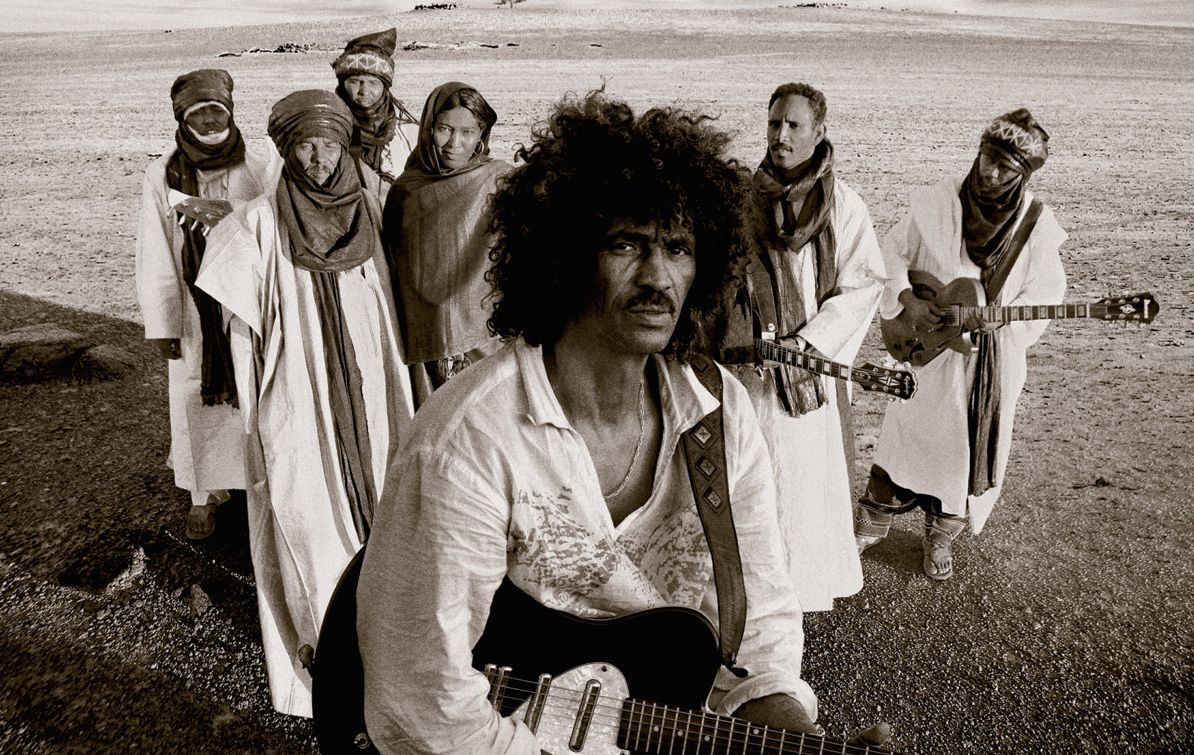
The modern history of the Sahara has a soundtrack: the Tuareg guitar. The desert is a place of hardship and quiet beauty, a desolate world that reveals its secrets slowly and carefully. Life there is resilient and strong, and the people are gentle giants amid the sand, the storms, and the sun.
Tuareg blues emerged in the 1980s, with the trailblazing band Tinariwen among its pioneers. Today it reaches across borders and has been knocking on the doors of other continents for some time. Lately, media coverage of the Tuareg people has focused solely on radical movements allied with Islamists in northern Mali. An entire people is suffering because of the territorial dispute, but the Tuareg people do not support the jihadist solution pursued by their most radical elements. Many artists explore this concern in their work. Here are a few of them.
Tinariwen
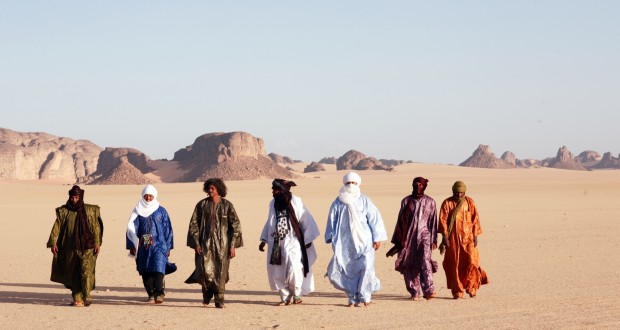
Tinariwen is to Tuareg blues what the Rolling Stones are to rock. The desert is their home, and their hypnotic rock, with its spellbinding guitars, reflects the complex realities of their home base in northern Mali.
Tinariwen began when three Tuareg men, Ibrahim Ag Alhabib, Hassan Touhami, and Inteyeden Ag Ableline, met in the Tamanrasset desert in Mali in 1979. The three became friends, and two women singers later joined them. They played a makeshift guitar to accompany their singing, blending raï and chaâbi with Malian blues and drawing inspiration from Ali Farka Touré, Aziz, Boubacar Traoré, Rabah Driassa, and even Kenny Rogers. At first, they simply played to entertain their community. In 1982, they were invited to play at the Algiers festival and were given an electric guitar for the occasion. Alhousseini Ag Abdoulahi, Mohammed “le Japonais,” and Kedhou Ag Ossad later joined them, and their involvement in music grew.
During the Tuareg rebellion of the late 1980s, they joined Iyad Ag Ghali’s MPA to take part in the 1990 uprisings in Mali and Niger. Their main focus was getting their music heard. It expressed the pain and longing of exile and carried messages of resistance and hope. The band gradually became a kind of collective with a shifting lineup as backing singers joined.
www.tinariwen.com
Tamikrest

In 2006, a group of young people in Kidal, in northwestern Mali, formed Tamikrest, which means “the gathering” in the Tuareg language. Led by Ousmane Ag Mossa, Tamikrest draws on Tinariwen and the rock of bands like Pink Floyd and Dire Straits. They grew up amid armed conflict and violence between the Tuareg people and the government in Bamako in the north of the country.
Ousmane Ag Mossa chose to express his identity through music rather than join the armed struggle. Tamikrest met the Australian-American band Dirtmusic at a Tuareg music festival in Essakane. Dirtmusic member Chris Eckman, of The Walkabouts, took Tamikrest under his wing. He helped the band produce its first album, Adagh, in 2009 and made its first European tour possible in 2010. Unfortunately, those encouraging signs were soon overshadowed by a grim reality as the arrival of radical Islamists in the region brought a new threat to the Tuareg people.
In 2011, Tamikrest recorded Toumastin, which means “my people,” and drew attention to divisions among the Tuareg people as this new element of the conflict split local residents. The tragic events of 2012 that led to French intervention in Mali unfortunately proved Tamikrest right. With a smaller lineup of just six members, including French guitarist Paul Salvagnac, Tamikrest released Chatma in September 2013. The album pays tribute to the suffering of women, who are often the first innocent victims of abuses committed by fighters on the various sides. Singer Wonou Walet Sinati plays a central role on the album and in the concerts that follow its release.
http://www.tamikrest.net/
Come back next week for the next part of our guide!