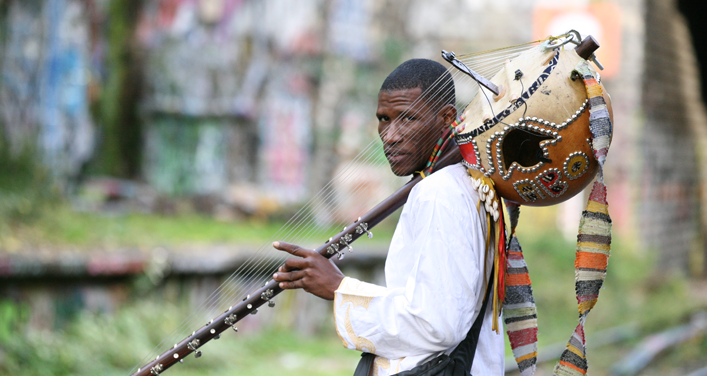
Shaped by the ancestral culture of Mandinka hunters, Abou Diarra plays the n’goni (a Malian harp guitar) and has followed an unusual, even strange path. Trained by a blind virtuoso, he spent several months traveling the roads linking Abidjan, Bamako, and Conakry… on foot, with only his instrument for company. As he passed through some of West Africa’s most remote villages and its sprawling modern cities, he drew on both hidden traditional sounds and contemporary urban music… His music speaks of travel, exile, and movement… He’s fascinated by blues, jazz, reggae, and groove… by rhythms and styles that bring together countries, sounds, and influences… Abou Diarra ventures beyond conventional scales, playing his n’goni like a guitar, a bass, a harp, or a percussion instrument… in quiet, nostalgic ballads or to the wild rhythms of dusty dance parties.
Abou Diarra is one of those rare artists who take on a new project only when they feel a deep inner need to do so. Koya, named in honor of his mother, who shared that name, grows out of years of musical reflection while heading in new directions.
For the first time, Abou works with Nicolas Repac’s interwoven samples and more electronic grooves, as well as the blues of harmonica player Vincent Bucher. On the kamele n’goni and in his singing, with skillful support from Toumani Diabaté and the musicians of the Donko Band, he stays rooted in a distinctly Malian musical spirituality. You can hear Abou Diarra’s passion in every note of this quietly rich album, which reflects who he is: utter sincerity, a wholehearted acceptance of life as a process of constant change, and, above it all, a serene sense of a higher harmony.
Source: http://gingersounds.com/