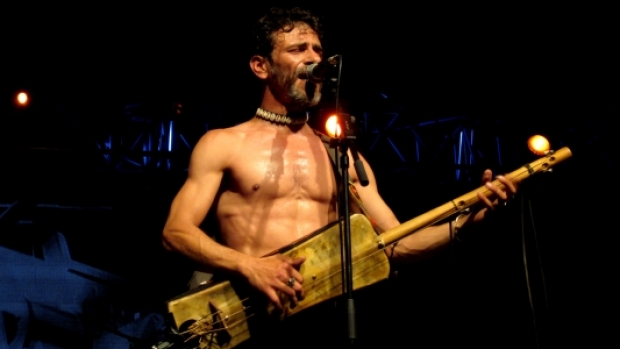
For more than twenty years, Amazigh Kateb has been on a long journey of experimenting with sound. With his Franco-Algerian collective Gnawa Diffusion, he has managed to create and share music born of unlikely fusions. Reggae, rock, jazz, rap, and other genres from across the Atlantic blend with Algerian chaabi and, above all, with Gnawa music. This Black Saharan community, made up largely of descendants of enslaved people, is the artist's main source of inspiration. We caught up with the singer and guembri player when he was in Tunis in May for an artist residency as part of the El Chanti festival.
T. M.: You've made African identity your calling since the early days of Gnawa Diffusion. What place does Arab identity have in your music?
A. K.: To me, it's first and foremost a world defined by language. A lot of countries think of themselves as Arab. But Arab identity isn't an ethnicity. It's mainly a culture and a language. And that language has taken shape in several dialects. So yes, I embrace the Arab identity you hear in those dialects, the Arab identity of the people. But I want nothing to do with the Arab identity of states, the kind those in power use to subjugate us. African identity is the cause I champion because it's where I feel at home musically. That doesn't mean I don't like Sabah Fakhri, Oum Kalthoum, Zied Rahbani, and others. Our culture is certainly Muslim and Arabized, but there's more to it. It has many facets.
T. M.: Religion is a strong presence in Arab culture, and it also has a very important place in Gnawa culture…
A. K.: One of the things that interests me most about Gnawa culture is the way it sees religion. It's a very modern way of thinking. Religion is generally used to subjugate people. You can see how petrodollars do that today. The Gnawa use it to free themselves, so that "Negroes" can be accepted in a white society. You embrace the oppressor's religion to win their heart. It's a very clever way of using Islam. It's a way to find salvation.
T. M.: This artist residency in Tunis is one of the few that bring together artists from the Maghreb. Why are there so few collaborations, so few opportunities for Tunisian, Algerian, and Moroccan artists to get together?
A. K.: In the Maghreb, musicians struggle to make a living. Money troubles are at the root of the problem. To get together and make art, you need to have eaten well. It's a kind of petty-bourgeois ritual. The way musicians work changes with the music business. There's experimental music, but there's no experimental music business. We also suffer from a certain lack of knowledge. Before this residency in Tunisia, for instance, I knew nothing about stambali. I'd only listened to two or three little bits.
T. M.: After more than twenty years with Gnawa Diffusion, how much has your own experience been shaped by the experiences of the generations of Maghrebi musicians who came before you?
A. K.: We soaked up music from the Maghreb. I personally devoured a lot of chaabi (popular music from the Maghreb). I listened to Nass El Ghiwane a lot. But I don't know Tunisian music or music from eastern Algeria. Music really doesn't circulate enough in the Maghreb, and that's a shame. Raï from western Algeria did travel widely. As for chaabi, I know it so well because I grew up with it. I lived in Algiers until I was 16. I discovered Gnawa music when I went south. At first, I wasn't even playing it right because I'd learned by listening to tapes. I didn't have a maalem, a master to teach me. It took me time.
T. M.: You announced the end of Gnawa Diffusion in 2007 after the release of Fucking Cowboys, the collective's fifth record. What brought the group back in 2012 with Shouk El Hal?
A. K.: I spent fifteen years on the road with the collective. I needed to get away and have a change of scene. We each had real work to do on our own to grow. Some members of the collective were starting to try other things. So we stopped before we "had a falling out." Things can go downhill fast in a band. We understood that, and it made it easier to come back five years later. After my solo album came out, I started with an acoustic tour. Then at some point, I felt the need to change the sound of my repertoire. I wanted to move toward a more rock-oriented sound. So I called the musicians from Gnawa Diffusion. They're like family to me. We got back together onstage, and that made us want to work on a new album together.
T. M.: What's your priority today? Your solo career or your work with Gnawa Diffusion?
A. K.: Right now, I have a solo album in the works. I think I'll start recording soon, or at least get started on preproduction. The other musicians in Gnawa Diffusion also want to make another album. Demos will start making the rounds among the members of the collective soon. Everyone has a hand in it. It takes time and depends on all the musicians wanting to do it.
T. M.: You've stayed true to the ideas and work of your father, Kateb Yacine. You used some of his writing on your solo album Marchez noir. Are you planning to do that again on your next record?
A. K.: Yes, there are a few poems, like “Là et ailleurs,” for example. Right now, I'm also working on “La rue des vandales.” It's a powerful, substantial theatrical prologue. It isn't easy to adapt it to music. I have several texts in the works. I'll tell you, I'm also working on a poem by Mahmoud Darwish right now. The next album is taking shape around songs of freedom, songs of slavery, prison, or exile. And of course, there's always some Gnawa music in there somewhere.
T. M.: Speaking of freedom, you protested against the Algerian regime in February 2011, and you supported the dissident Barakat movement against Abdelaziz Bouteflika's reelection. Did the protest movement achieve even some of its goals?
A. K.: Not really. I think Algeria is coming to its senses. Some things are changing, but only on the surface. For example, a few ministers have just been fired. I assume the president will resign before too long, since everything is in place for what comes next. Now that Ali Baba is ready, Bouteflika can leave.
T. M.: A lot is changing in the Arab world. Are artists playing their part fully?
A. K.: I think there's a lot more they could be doing. They're more inclined to go along with the system than to fight it. The music circuit is pretty limited in our countries, and artists have very few opportunities, so the best of them often rush into mainstream pop. Unfortunately, they're completely out of touch with what they could do with the influence they have and the audience they could reach. Times are hard, but things won't get better by "prostituting" yourself.
Author: THAMEUR MEKKI